
When a big-box store or a national chain opens nearby, many local shop owners feel the ground shift. The chain has bigger ad budgets, deeper inventory, longer hours and prices negotiated at a scale no independent business can match. Trying to beat them on their terms usually ends badly. The good news is that you do not have to. Local shops win by competing on the things large retailers struggle to deliver.
This guide explains how small businesses compete with big box stores in practical ways: choosing where to stand out, building service and expertise into every visit, curating products, using community ties, making your shop visible locally, and running numbers so your pricing stays sustainable. Each section includes steps you can start this month.

Do not try to win on price alone
Large retailers buy in enormous volumes and can often sell some items below what you pay wholesale. A price war is a fight you are unlikely to win, and it drains the margin you need for staff, rent and reinvestment.
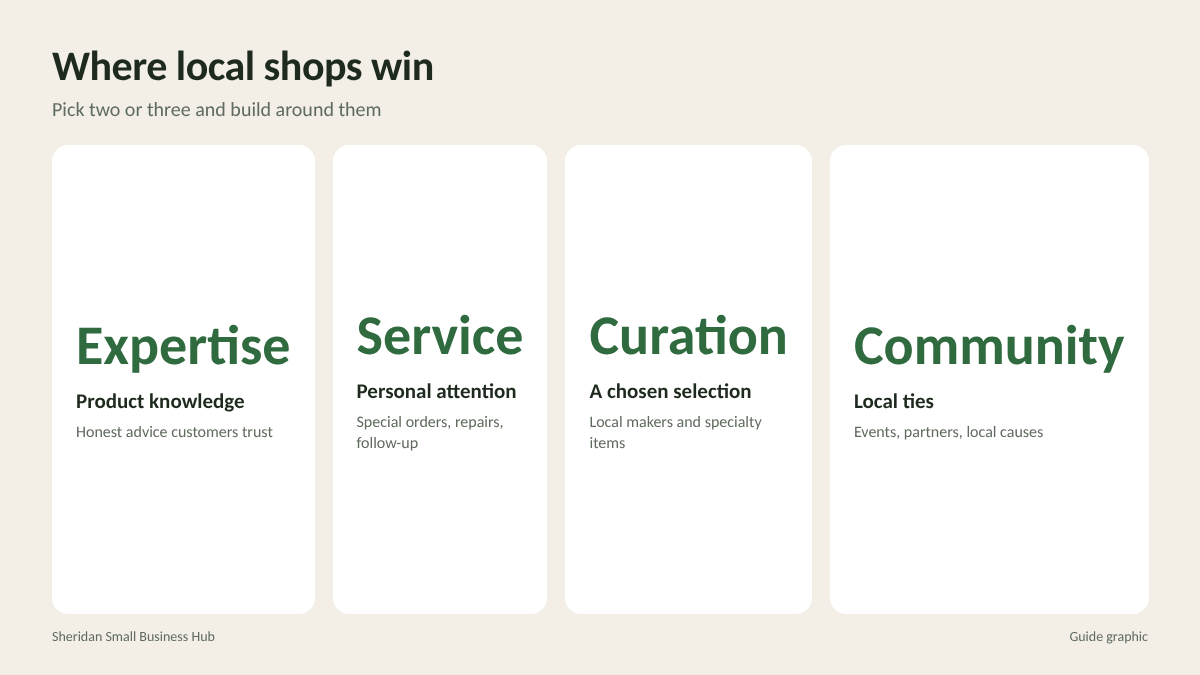
Instead, decide where you will be clearly better. Most successful independents pick two or three of these:
- Expertise: Staff who know the products deeply and give honest advice.
- Service: Personal attention, special orders, repairs, setup, follow-up.
- Curation: A carefully chosen selection that saves customers from sorting through hundreds of options.
- Convenience: Location, parking, short lines, fast in-and-out visits, local delivery.
- Community: Local ownership, events, partnerships and a sense of belonging.
- Experience: A shop people enjoy visiting, not just a place to buy something.
Write your two or three choices down and share them with your whole team. Every decision about hiring, merchandising and marketing should support them.
Make expertise your biggest advantage
In a large store, customers often struggle to find someone who can answer a detailed question. In your shop, expertise can be the reason people come back.
- Train staff on products, not just the register. Short weekly product briefings build knowledge quickly.
- Give honest recommendations, including “you do not need the expensive one.” That honesty builds trust that outlasts any single sale.
- Offer help beyond the sale: setup advice, care instructions, how-to demonstrations or a follow-up call.
- Share knowledge publicly through workshops, short how-to videos, printed guides at the counter and social posts that answer common questions.
Deliver service a chain cannot copy
Big-box stores are built for efficiency at scale, which often means standardized policies and limited flexibility. You can be personal.
- Learn names and preferences. A simple customer notes system lets staff remember what regulars like.
- Offer special orders for items you do not stock.
- Make problems easy to fix. A fair, flexible return or repair policy can turn a complaint into loyalty.
- Add services that fit your products, such as gift wrapping, alterations, assembly, local delivery or shipping a purchase for a customer.
- Follow up after big purchases with a note or call to check that everything is working.

Curate instead of competing on selection
You cannot stock everything, and you should not try. Curation turns your limited shelf space into a strength.
- Know your best customers. Who buys most often, and what do they value?
- Stock what chains do not. Local makers, specialty brands, higher-quality versions and niche products are harder for large retailers to offer.
- Edit ruthlessly. If an item does not sell or does not fit your identity, discontinue it.
- Tell the story. Shelf tags and signs that explain why a product is special help it sell without a salesperson at every aisle.
- Rotate seasonal and limited items so regulars have a reason to visit often.
Build community ties
Being local is a real advantage when you make it visible.
- Host events: classes, demos, tastings, meetups or kids’ activities that bring people into the shop for reasons other than buying.
- Partner with neighbors: cross-promote with nearby businesses that serve the same customers, such as a bakery and a florist, or a bike shop and a coffee shop.
- Support local causes: sponsor a school event or a youth team, or collect donations for a local charity.
- Join local business groups and neighborhood associations to build relationships and referrals.
- Feature local makers on your shelves and tell customers about them.
Make your shop easy to find and remember
Chains spend heavily to stay top of mind. You can stay visible locally with focused, affordable tactics.
- Keep your Google Business Profile complete and current, with hours, photos, products and replies to reviews. Google requires a real physical location for a storefront profile, which works in your favor as a local shop.
- Ask happy customers for reviews in a natural, honest way.
- Use strong storefront signage and window posters to catch people walking or driving by.
- Print simple materials that travel: postcards with an offer for first-time visitors, business cards in every bag, flyers for local events.
- Run a loyalty program that rewards repeat visits rather than discounting everyone.
- Keep an email list for events, new arrivals and seasonal news. It costs little and reaches people who already like you.

Price smart, not low
You still need prices customers accept, but you can be strategic.
- Match on a few “known value” items that customers compare everywhere, so you do not look overpriced.
- Earn margin on curated and specialty items that customers cannot easily compare.
- Bundle products with services, such as an item plus setup, which adds value without discounting.
- Explain the value behind your prices: warranty help, expertise, quality.
Worked example: you sell a popular kitchen tool for $30 that a chain sells for $27. Rather than cutting the price, you include a free 20-minute demo and a printed care guide. If the item costs you $15, selling at $30 earns $15 per unit. Matching the chain at $27 would earn $12. Over 200 units a year, keeping your price with added value earns 200 x $3 = $600 more than matching, while giving customers a reason to choose you.
Measure what keeps customers coming back
Track a few simple numbers each month: number of transactions, average sale, share of sales from repeat customers, new reviews and event attendance. If repeat sales grow, your strategy is working, even when a chain has lower prices on some items.
You do not need special software to start. Most point-of-sale systems can show repeat customers if you collect a name, email or phone number at checkout. A loyalty card program gives you the same information on paper. Review the numbers alongside what customers say, both in reviews and in conversations at the counter, since comments often explain the trends before the data does.
Questions to ask every quarter
- Which products or services do customers mention when they tell friends about us?
- Where did we lose a sale to a chain, and was it price, selection or convenience?
- Which events or partnerships brought new faces into the shop?
- What is one service we could add that a large retailer would find hard to copy?
Use the answers to adjust one thing at a time. Small, steady improvements in service and selection compound over months, and they are much harder for a competitor to match than a temporary discount.
Frequently asked questions
Can a small shop survive next to a big-box store?
Yes, many do, by focusing on expertise, service, curation, convenience and community rather than trying to match the chain on price and selection.
Should I price match big retailers?
Consider matching on a few widely compared items, but avoid matching across the board. Protect margin on curated and specialty products.
What is the cheapest way to market a local shop?
Keep your Google Business Profile current, ask for reviews, use storefront signage, partner with neighbors and build an email list of existing customers.
How do local events help sales?
Events bring people into the shop, build relationships and give regulars a reason to return and bring friends.
Need signage and print to stand out locally?
Window posters, banners, postcards and flyers help a local shop stay visible. Poster, banner and flyer printing in Houston at The Postal Spot can help you get them made quickly.