
One of the first questions new Houston business owners ask is simple: “Where do I get my business license?” The answer is surprisingly complicated. There is no single office that hands out one license covering everything. Instead, the permits and registrations you need depend on what you do, how your business is structured, where you operate and whether you sell taxable goods or services.
This guide gives you a practical starting map of Houston business license requirements and related registrations. It covers federal, state, county and city layers, the most common permits small businesses run into, how to research what applies to you, and how to keep everything current. Rules and fees change, so treat this as a checklist of questions to confirm with the official agencies, not as legal advice.

Why there is no single “Houston business license”
Texas does not issue a general statewide business license that every company must hold, and the City of Houston does not issue one general license for all businesses either. Instead, specific activities trigger specific requirements. A home-based consultant may need very little beyond basic registrations, while a restaurant needs health permits, building approvals, a certificate of occupancy and more.
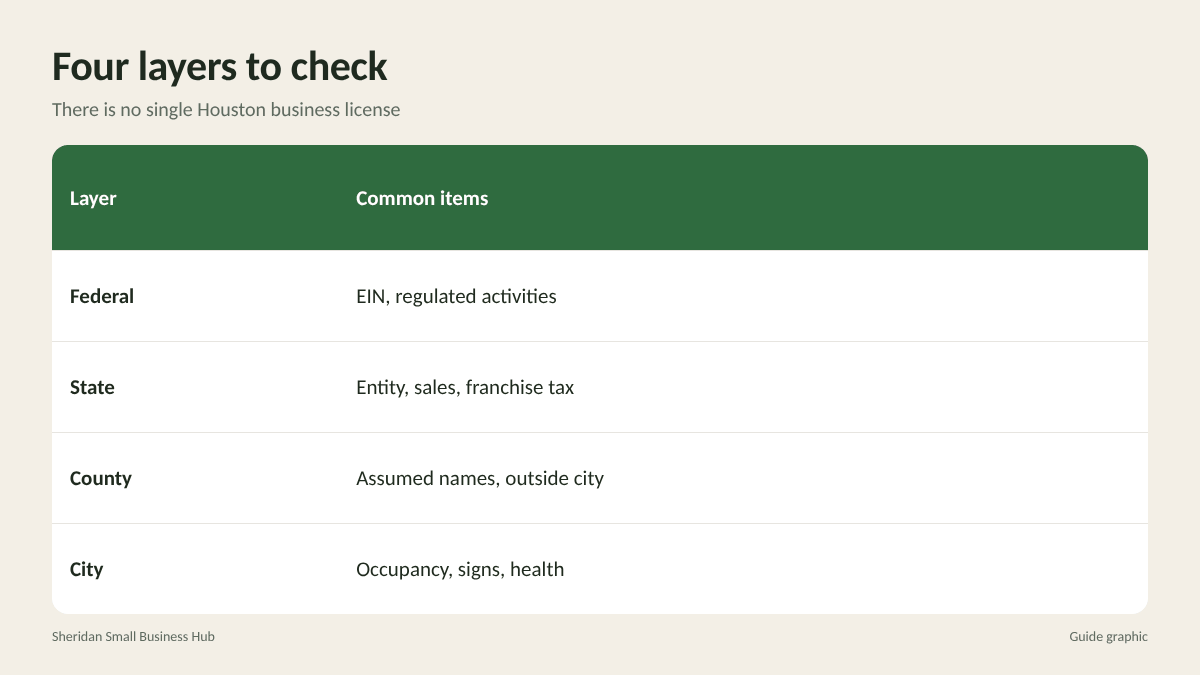
Think of it in layers. Work through each one and note what applies to you:
- Federal: tax ID and any federally regulated activities
- State: business entity registration, sales tax permits, franchise tax and occupational licenses
- County: assumed name filings for some businesses, and rules for unincorporated areas
- City: building, occupancy, signs, health and activity-specific permits
Federal layer: your EIN and regulated activities
An Employer Identification Number (EIN) is a federal tax ID issued by the IRS. You need one if you have employees, operate as a corporation or a multi-member LLC, or meet other IRS criteria, and many banks ask for one when you open a business account. You can apply directly on the IRS website; avoid third-party sites that charge for something you can do yourself.
A small number of activities, such as selling alcohol, firearms or certain agricultural products, or providing some transportation services, also involve federal permits. If your business touches a regulated product, check the relevant federal agency early.
State layer: entity, taxes and occupational licenses
Forming your business entity
LLCs, corporations and limited partnerships are created by filing with the Texas Secretary of State. Sole proprietors and general partnerships do not file formation documents with the state, but they may need an assumed name filing (see below).
Sales and use tax permit
If you sell taxable goods or taxable services in Texas, you generally need a sales and use tax permit from the Texas Comptroller of Public Accounts before you start selling. This applies to many retail shops, online sellers shipping to Texas customers and some service businesses. The Comptroller’s website explains which items and services are taxable.
Franchise tax
Most LLCs and corporations in Texas are subject to the state franchise tax and must file annual reports with the Comptroller, even if no tax is due. Mark the annual due date on your calendar and confirm details with your accountant.
Occupational and professional licenses
Many trades and professions are licensed by state agencies rather than the city. Examples include cosmetology and barbering, electricians, air conditioning and refrigeration contractors, real estate agents, insurance agents, child care providers and many health professions. Each licensing agency sets its own exams, renewals and continuing education rules.
County layer: assumed names and unincorporated areas
Assumed name (DBA) certificates
If you do business under a name other than your legal name or registered entity name, Texas requires an assumed name certificate. Sole proprietors and general partnerships usually file with the county clerk in the county where they do business (Harris County for most Houston businesses). LLCs and corporations file assumed names with the Texas Secretary of State. Read the form instructions carefully: some filings require a signature in front of a notary.
Inside or outside city limits?
The greater Houston area includes many addresses outside the City of Houston’s limits, in unincorporated Harris County or in separate cities such as Bellaire or West University Place. City of Houston permits apply only inside city limits. If you are outside them, check with the county or the city where your business is located, since rules and agencies differ.
City layer: common Houston permits
Inside Houston city limits, these are the permits small businesses most often encounter. The Houston Permitting Center is the main starting point for building, occupancy and many related permits, and the city’s business resources pages list others.
- Certificate of Occupancy: Generally required before you occupy a commercial space, especially for a new business, a change in use or after construction. Check this before you sign a lease, because a space approved for one use may need changes for another.
- Building and renovation permits: For construction, remodeling, electrical, plumbing and mechanical work.
- Sign permits: Many exterior signs need approval before installation.
- Food and health permits: Restaurants, food trucks, caterers and other food businesses deal with the city’s health department.
- Alarm permits: Businesses with monitored burglar alarms may need to register them.
- Activity-specific permits: Certain industries, such as secondhand dealers, automotive repair, mobile vending and some entertainment venues, have their own permits or registrations.
How to find exactly what applies to you
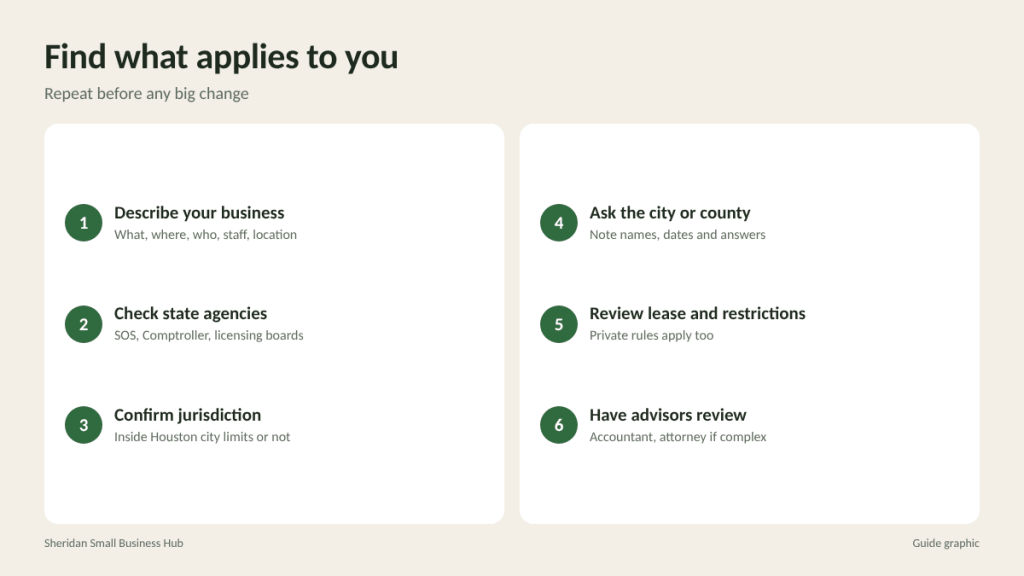
Use this research routine before you open, and again before any big change such as moving, renovating or adding a new service:
- Write a one-paragraph description of your business: what you sell, where, to whom and whether you have employees or a physical location.
- Check the state. Search the Texas Secretary of State, Comptroller and any licensing agency for your industry.
- Confirm your jurisdiction. Look up whether your address is inside City of Houston limits.
- Contact the city or county. Describe your business and ask which permits apply. Ask for answers in writing or note the date, name and response.
- Review your lease and property rules. Commercial leases and deed restrictions can limit how a space is used, separate from city permits.
- Ask your accountant and, for complex situations, an attorney to review your list.

Keep your permits organized and current
Getting permits is only the start. Many require renewal, display or updates when details change.
- Build a permit register: a simple spreadsheet listing each license or permit, the issuing agency, number, issue date, expiration date, renewal steps and the person responsible.
- Calendar renewals 60 to 90 days ahead, since some require inspections, continuing education or new documents.
- Display permits where required, such as health permits or certificates of occupancy.
- Update records when things change: a new address, owner, name or type of service can require amendments.
- Keep copies in two places: originals in a secure file and scans in your digital records.
Worked example: if you hold 6 permits and registrations, and each needs about 2 hours of prep for renewal each year, you are planning for 6 x 2 = 12 hours of permit admin annually. Spreading those hours across the calendar, rather than discovering them the week something expires, keeps renewals from becoming emergencies.
Frequently asked questions
Does Houston require a general business license?
The city does not issue a single general license for every business. Instead, specific activities and locations require specific permits, such as a certificate of occupancy, sign permits or health permits.
Do I need a sales tax permit to sell online from Houston?
If you sell taxable items to Texas customers, you generally need a Texas sales and use tax permit from the Comptroller. Check the Comptroller’s guidance for your products.
Where do I file a DBA in Houston?
Sole proprietors and general partnerships usually file with the county clerk where they do business. LLCs and corporations file with the Texas Secretary of State.
Does a home-based business in Houston need permits?
Often fewer than a storefront, but you still need any required state registrations, tax permits and licenses for your trade, and you should check deed restrictions for your property.
Application needs a notarized signature?
Some filings and affidavits must be signed in front of a notary. The Postal Spot provides walk-in notary services in Houston, so you can finish the paperwork without booking an appointment.