
The first international order is exciting for a small online store. Then the questions arrive. Which carrier should you use? What goes on the customs form? Who pays the import duties? What if the package gets stuck at the border? Many small sellers either turn international orders off entirely or accept them and hope for the best, and neither approach builds a reliable global customer base.
This guide covers international ecommerce shipping for small business sellers in practical terms. You will learn how to decide whether to sell abroad, how to pick countries and carriers, how to complete customs paperwork correctly, how to handle duties and taxes so customers are not surprised, what you cannot ship, and how to set policies that keep international orders profitable.

Decide whether international shipping fits your store
International orders can grow sales, but they are not right for every product or every store yet. Consider:
- Product value and weight. International postage can be high relative to a low-priced item. Lightweight products with healthy margins usually travel best.
- Restrictions. Some products face strict rules or bans in certain countries. Check before you list.
- Demand. Look at your analytics: are visitors already arriving from other countries? Have customers asked whether you ship to them?
- Your capacity. International orders take more time per order for paperwork and customer questions, at least at first.
A sensible approach is to start with a few countries where demand already exists, learn the process on a small number of orders, then expand.
Choose your first countries
Rather than opening shipping to the whole world on day one, pick two to five countries based on visitor data, customer requests and ease of shipping. Many US sellers start with Canada and the United Kingdom because of shared language and strong demand for US products, but your own data should guide the choice.
For each country, research the basics before you go live:
- Products that are prohibited or restricted
- How duties and import taxes are charged, and roughly when they apply
- Typical delivery times by service
- Any labeling or documentation requirements for your product type
Pick carriers and service levels
You generally have two kinds of options:
- Postal services (USPS international): Often economical for lightweight packages. After leaving the US, packages are handled by the destination country’s postal service, so tracking detail and delivery speed can vary.
- Express carriers (FedEx, UPS): Usually faster with more detailed tracking end to end, and often better for higher-value or time-sensitive orders. Rates can be higher, especially for light packages.
Many stores offer both at checkout: an economy postal option and an express option. Use shipping software that shows rates side by side and generates customs documents automatically.
Get customs paperwork right
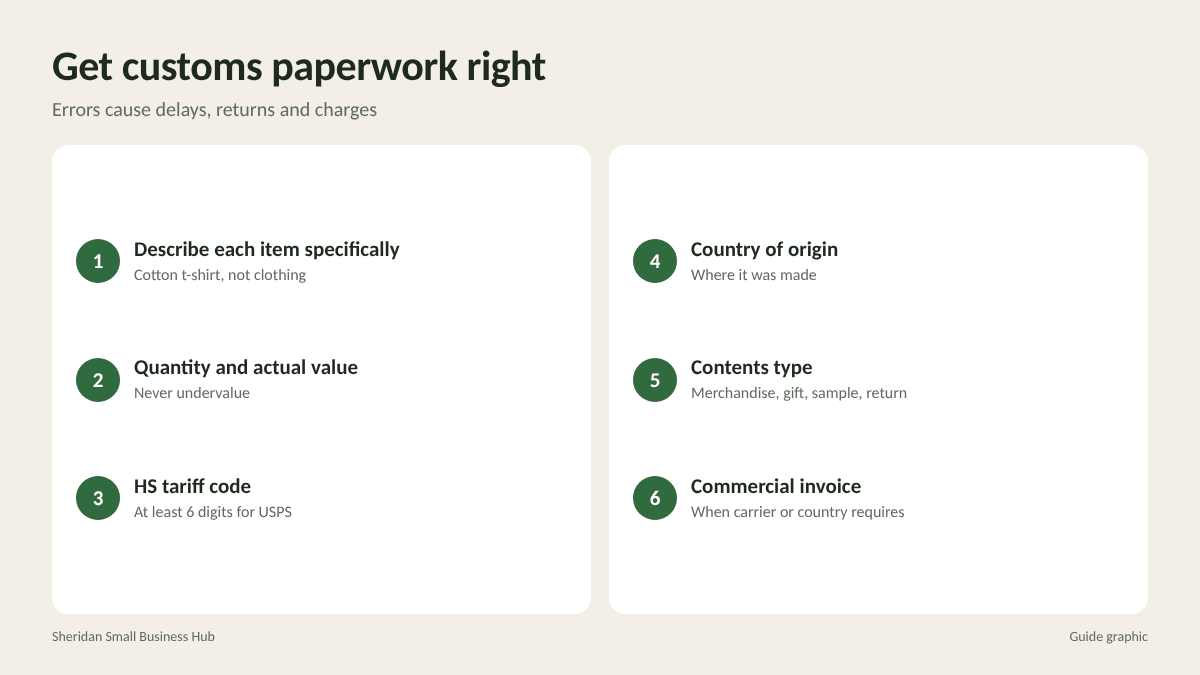
Every international package needs a customs declaration describing what is inside. Errors here are one of the most common causes of delays, returns and unexpected charges.
- Describe each item specifically. “Women’s cotton t-shirt” rather than “clothing”; “ceramic coffee mug” rather than “gift.”
- Enter the quantity and value of each item. Declare the actual sale price. Undervaluing to reduce the customer’s duties is illegal and can cause seizures or penalties.
- Add the HS tariff code. Harmonized System codes classify goods for customs. USPS has required at least a 6-digit HS code for each item on international shipments since September 1, 2025, and express carriers ask for them as well.
- State the country of origin, meaning where the item was made, not where you shipped it from.
- Mark the contents type correctly, such as merchandise, gift, sample or return.
- Include a commercial invoice when the carrier or destination requires one, typically for commercial shipments with express carriers.
Save HS codes and customs descriptions in your product catalog so your software fills them in automatically on every order.
Handle duties and taxes without surprising customers
Most countries charge import duties and taxes (such as VAT or GST) on goods above certain thresholds. The rules vary widely and change from time to time, so check each country’s current requirements or rely on your carrier or software’s duty calculator.
You have two broad choices:
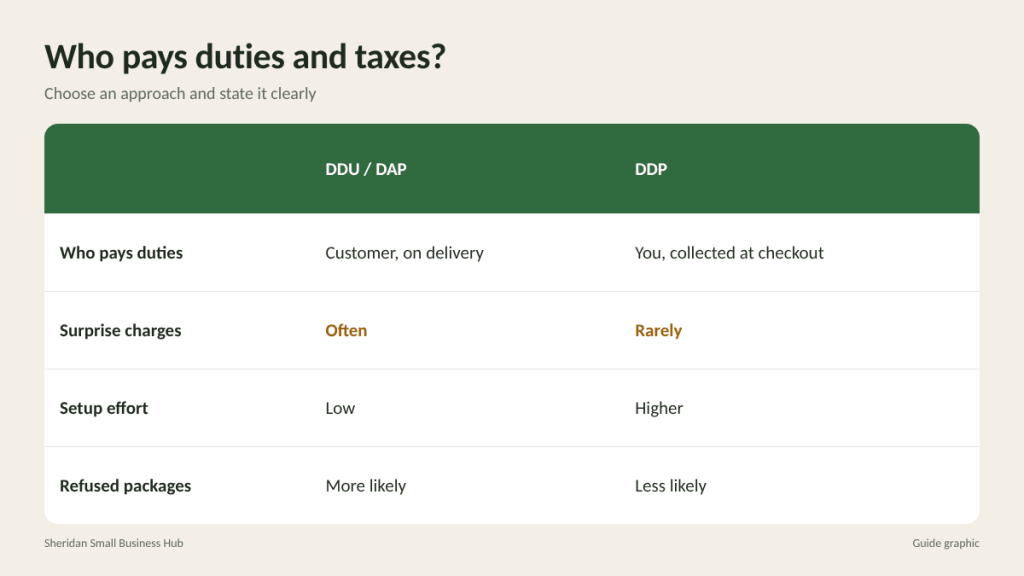
- Delivered Duty Unpaid (DDU or DAP): The customer pays duties and taxes on delivery. Your prices look lower, but surprise charges can lead to refused packages and unhappy customers.
- Delivered Duty Paid (DDP): You collect duties and taxes at checkout and pay them, so the customer has nothing to pay on arrival. This costs more to set up but gives customers a much better experience.
Whichever you choose, state it clearly on your shipping policy and at checkout. A line like “International orders may be subject to import duties and taxes, which are the buyer’s responsibility” sets expectations and reduces disputes.
Know what you cannot ship
Every carrier and every destination has its own list of prohibited and restricted items. Common categories that need extra care include:
- Lithium batteries and devices containing them
- Perfumes, nail polish, aerosols and other flammable items
- Food, plants, seeds and animal products
- Alcohol and tobacco
- Cosmetics and supplements in some countries
- Items made from protected materials
Check both the carrier’s international guide and the destination’s import rules before you list a product as available internationally.
Pack for a longer, rougher trip
International packages travel farther, change hands more often and may sit in customs warehouses before delivery. Packaging that survives a two-day domestic trip may not survive two weeks abroad.
- Use a sturdy corrugated box rather than a thin mailer for anything breakable.
- Add extra cushioning so items cannot shift, and seal seams fully with packing tape.
- Place the customs form and label where they are easy to see and read, without covering seams.
- Put a copy of the invoice inside the box in case the outer documents are damaged.
- Write addresses in the format the destination expects, including postal code and country on the last line.
A complete phone number and email for the recipient also helps carriers and customs officers contact them if there is a question about the delivery.
Set policies that protect your margins
International orders cost more to fulfill and are harder to fix when something goes wrong. Protect yourself with clear rules:
- Charge real shipping costs or set a separate international flat rate. Domestic free shipping offers rarely work abroad.
- Set a minimum order value for international orders if small orders are not worth the effort.
- Define returns clearly. Decide whether you accept international returns, who pays return shipping and whether duties are refundable.
- Use tracked services for valuable orders, and consider insurance or declared value coverage.
- Communicate delivery estimates honestly, including potential customs delays.
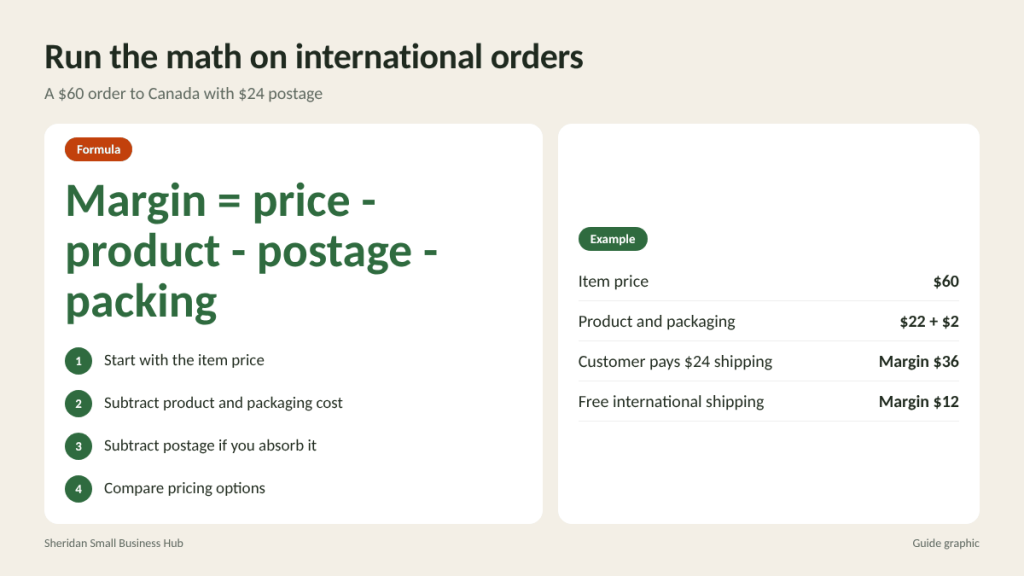
Worked example: a customer in Canada orders a $60 item. Your product cost is $22, international postage is $24 and packaging is $2. If you charge the customer $24 for shipping, your margin is 60 – 22 – 2 = $36. If you offered free international shipping, it would fall to 60 – 22 – 24 – 2 = $12, which may not justify the extra time. Running this math for your typical orders shows which pricing approach makes sense.
Frequently asked questions
Do I need an HS code for every product?
For USPS international shipments, yes: at least a 6-digit HS code per item has been required since September 1, 2025. Express carriers also use HS codes to process customs.
Who pays customs duties on international orders?
Usually the buyer pays on delivery, unless you ship Delivered Duty Paid and collect duties at checkout. State your approach clearly in your policy.
Is USPS or FedEx better for international shipping?
USPS is often more economical for lightweight items. FedEx and UPS tend to be faster with more detailed tracking, which suits higher-value or urgent orders.
Can I mark a sale as a gift to avoid duties?
No. Commercial sales must be declared as merchandise at their actual value. Misdeclaring can lead to delays, seizures and penalties.
Shipping your first international orders?
Having someone check your paperwork can prevent costly delays. The Postal Spot is a FedEx Authorized ShipCenter in Houston that also offers UPS and USPS international services for small sellers.