
Many small businesses run for years on handshakes, emails and good intentions. That works until a partner leaves, a client refuses to pay, an employee walks off with a customer list or a landlord disputes who owes what. At that point, the question is simple: what does the paperwork say? If there is no paperwork, the answer is often expensive.
This guide covers the legal documents for small business owners that matter most, grouped by purpose: formation and ownership, customers, employees and contractors, property and protection. For each one, you will see what it does, when you need it and how to keep it organized. It is general information, not legal advice, so have an attorney review anything with serious money or liability attached.
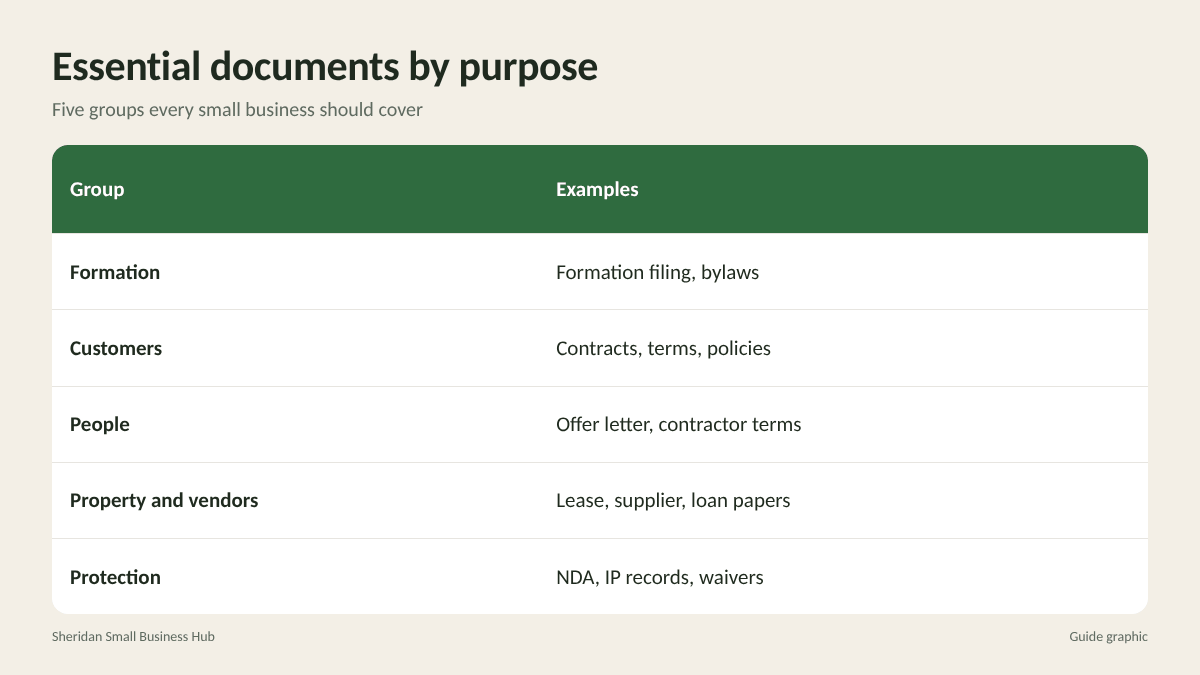
Formation and ownership documents
These documents prove your business exists and spell out who owns and controls it.
Formation filing
If you formed an LLC or corporation, you filed a certificate of formation (the name varies by state) with the state. Keep the stamped or filed copy, plus the confirmation notice, in a permanent file. Banks, landlords and some vendors may ask for it.
Operating agreement or bylaws
An LLC’s operating agreement, or a corporation’s bylaws, sets out how decisions are made, how profits are shared, what happens when an owner wants out, and what happens if an owner dies or becomes unable to work. Even a single-member LLC benefits from one, because it helps show the business is separate from you personally. For businesses with more than one owner, it is one of the most important documents you will ever sign.
Buy-sell provisions
Often part of the operating agreement, buy-sell terms describe how an owner’s share is valued and bought out. Without them, a departing partner’s share can end up in the hands of a spouse or heir who has no interest in running the business.
Assumed name records and licenses
If you operate under a name that differs from your legal business name, keep a copy of your assumed name (DBA) filing. Also keep copies of any permits and licenses with their renewal dates.
Customer-facing documents
These protect your revenue and set expectations before problems start.
- Service agreement or contract: Defines the scope of work, price, payment terms, deadlines, what happens if either side cancels, and how disputes are handled. A one-page agreement signed before work starts prevents most “I thought that was included” arguments.
- Quotes and estimates: State how long the quote is valid and what is excluded.
- Invoices with clear terms: Due date, accepted payment methods and any late payment policy you have stated in your agreement.
- Terms and conditions: For online sales, these cover ordering, payment, shipping, returns, warranties and limits of liability.
- Privacy policy: If you collect customer information online, a privacy policy explains what you collect and how you use it. Certain platforms and payment providers require one.
- Return and refund policy: Posted where customers can see it before they buy.
Employee and contractor documents
People paperwork has legal requirements that are easy to miss when you are hiring quickly.
For employees
- Offer letter: Job title, pay, start date and whether employment is at-will.
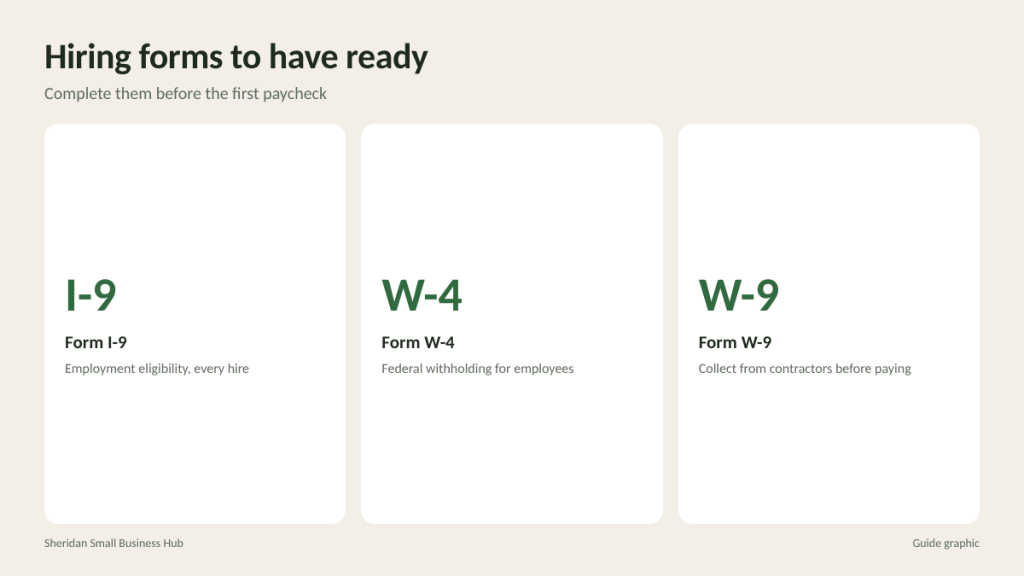
- Form I-9 and Form W-4: Federal employment eligibility verification and federal tax withholding forms, completed for every new hire.
- Employee handbook: Policies on hours, time off, conduct and safety, with a signed acknowledgment from each employee.
- Confidentiality or invention assignment agreement: Clarifies that work product and confidential information belong to the business.
For independent contractors
- Independent contractor agreement: Describes deliverables, payment, deadlines, ownership of the work and the contractor’s responsibility for their own taxes and tools.
- Form W-9: Collected before you pay, so you have the information needed for year-end tax reporting.
Calling someone a contractor does not make them one. How much control you have over when, where and how they work affects their classification. If you are unsure, ask an employment attorney or your accountant before the relationship starts.
Property, vendor and financing documents
- Commercial lease: Your rent, term, renewal options, who pays for repairs and what happens if you need to leave early. Read it before you sign, not after a dispute.
- Vendor and supplier agreements: Pricing, delivery terms, minimums and how either side can end the relationship.
- Equipment leases: Term, buyout options, maintenance responsibility and any minimum usage or overage terms.
- Loan documents and personal guarantees: Know exactly which debts you have personally guaranteed, because those can follow you even if the business closes.
- Insurance policies: Keep the declarations pages and know your renewal dates and coverage limits.
Protection documents
- Nondisclosure agreement (NDA): Use before sharing sensitive pricing, product plans or customer information with a potential partner, vendor or buyer.
- Intellectual property records: Trademark filings, copyright registrations, domain name records and proof of who created your logo and content.
- Liability waivers: For businesses with physical activities (fitness, events, rentals), a waiver can help set expectations, though its enforceability depends on how it is written and state law.
- Business continuity or succession instructions: Who can access accounts, sign checks and make decisions if you are suddenly unavailable.
Signing, notarizing and storing your documents
When signatures need more than a pen
Most business contracts are valid with ordinary signatures or e-signatures. Some documents, however, typically require notarization, such as many real estate documents, certain affidavits, powers of attorney and some documents that will be filed with a government office or used abroad. A notary verifies the identity of the signer; they do not review whether the document is fair or legal. Bring valid photo ID, and do not sign the document before you meet the notary if it needs a notarized signature.
A simple storage system
- Permanent file: Formation documents, operating agreement or bylaws, ownership records, trademark filings.
- Active contracts file: Leases, customer and vendor agreements, loans, insurance, with renewal dates on your calendar.
- Personnel files: One per employee, kept separately from general business files and with restricted access.
- Digital backup: Scan signed originals and store copies in an access-controlled cloud folder.
- Secure disposal: When documents reach the end of their retention period, shred them rather than recycling them.
Which documents to prioritize first
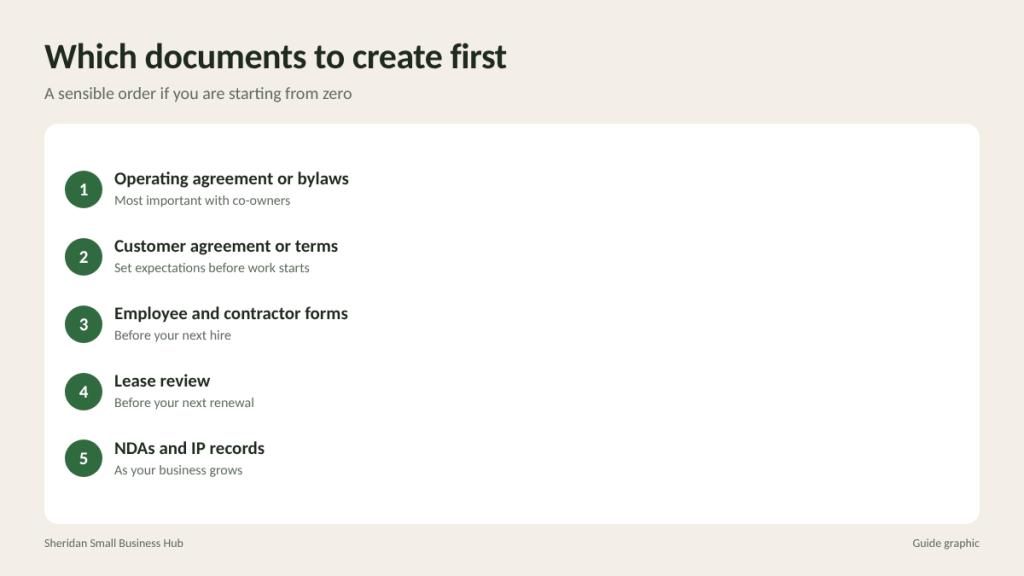
If you are starting from nothing, do not try to create everything in a week. A sensible order:
- Operating agreement or bylaws, especially with co-owners.
- A standard customer agreement or terms and conditions.
- Employee and contractor forms before your next hire.
- A lease review before your next renewal.
- NDAs and intellectual property records as you grow.
Common mistakes to avoid
- Signing in your own name instead of the company’s. Sign as an officer or member, with your title, so the business, not you personally, is the party.
- Using a template without reading it. Generic forms often include terms that do not fit your state or industry.
- Keeping only unsigned drafts. Always file the fully signed final version, including any amendments.
- Losing track of renewals. Automatic renewal clauses can lock you in for another full term if you miss the notice window.
Set a yearly reminder to review your core documents. Businesses change, and an agreement written when you had one product and no staff may not fit how you operate three years later.
Frequently asked questions
Do I need a lawyer to create business documents?
Templates can work for simple, low-risk documents. For operating agreements with multiple owners, leases, loans and anything involving large sums, an attorney review is worth the cost.
Does a single-member LLC need an operating agreement?
It is not always legally required, but it is strongly recommended. It documents how the business runs and supports the separation between you and the company.
Which business documents need to be notarized?
Most everyday contracts do not. Notarization is common for real estate documents, affidavits, powers of attorney and some government or international filings. Check the requirements of whoever will receive the document.
How long should I keep signed contracts?
Keep them for as long as they are active, plus a period afterward based on your accountant’s or attorney’s advice. Keep formation and ownership records permanently.
Need a signature notarized?
Some business documents need a notary before they are complete. The Postal Spot offers walk-in notary service in Houston with no appointment needed, so bring your document and valid photo ID.