
Overhead is the money you spend just to keep the doors open: rent, software, insurance, utilities, supplies and the dozens of small subscriptions that pile up over time. None of it directly produces a sale, and that is exactly why it tends to grow unnoticed. When revenue dips or prices rise, overhead is often the first place owners look, but cutting the wrong things can hurt service, slow your team down or cost you customers.
This guide shows you how to reduce overhead costs in a small business the careful way. You will learn how to build a clear picture of where the money goes, which categories usually hold the easiest savings, how to judge whether a cut is worth it, and how to keep costs from creeping back once you have trimmed them.
What counts as overhead (and what does not)
Before you cut anything, separate overhead from the direct costs of making or delivering what you sell. Direct costs (materials, inventory, the shipping you charge customers for, contractor time billed to a client) rise and fall with sales. Overhead mostly stays put no matter how busy you are.
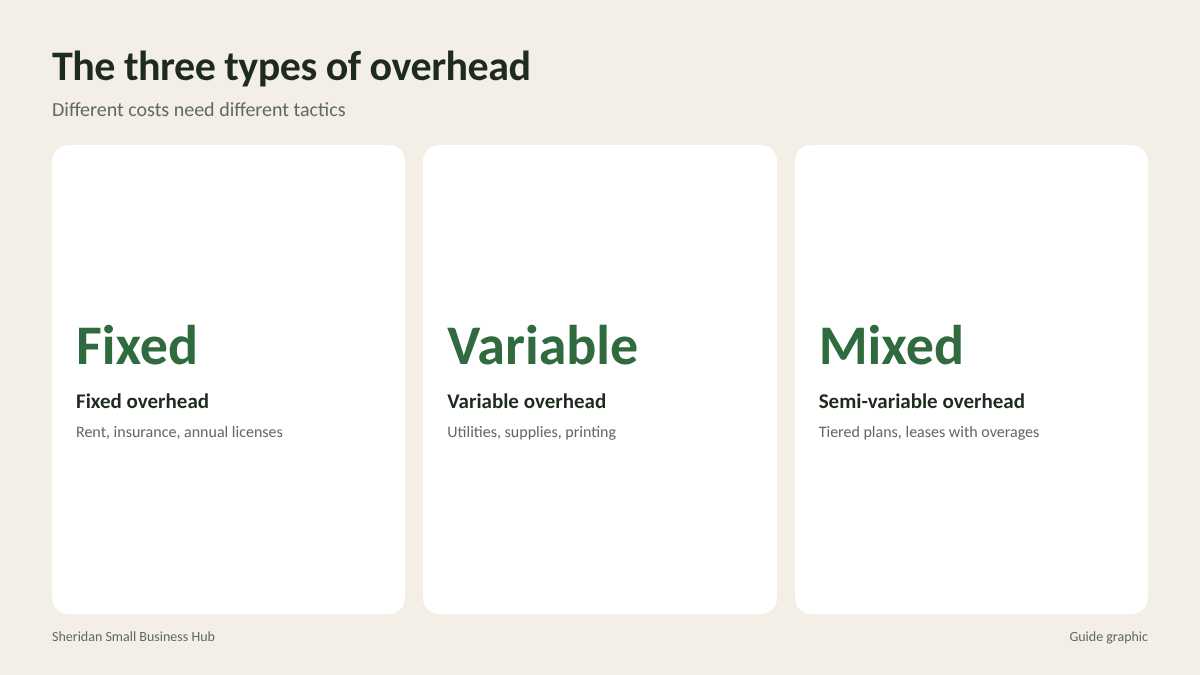
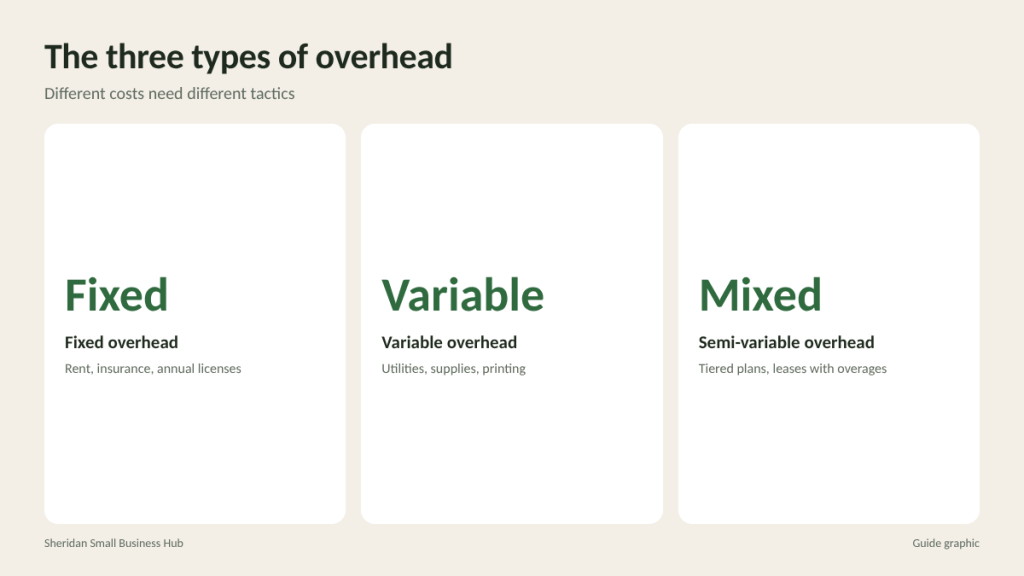
- Fixed overhead: rent, insurance premiums, loan payments, salaried admin staff, annual software licenses.
- Variable overhead: utilities, office supplies, printing, postage for business mail, maintenance and repairs.
- Semi-variable overhead: phone and internet plans with usage tiers, equipment leases with overage charges, part-time hours that flex with the season.
The distinction matters because the tactics differ. Fixed costs usually need a renegotiation or a structural change to shrink. Variable costs respond to better habits and purchasing systems.
Step 1: Build a 12-month overhead list
You cannot cut what you cannot see. Export 12 months of transactions from your bank, credit cards and accounting software, and sort every recurring business expense into a simple spreadsheet with these columns:
- Vendor or expense name
- Category (rent, software, insurance, supplies, utilities, services)
- Monthly cost, or annual cost divided by 12
- Contract end or renewal date
- Owner (the person who uses it or approved it)
- Value rating from 1 to 3 (1 = essential, 2 = useful, 3 = rarely used)
Twelve months matters because annual renewals, quarterly bills and seasonal spending do not show up in a single month. Many owners find charges they forgot existed, such as a trial that converted to a paid plan or a duplicate tool two people signed up for separately.
Step 2: Go after the easiest savings first
Some categories almost always hold savings without touching anything customers notice. Start here.
Software and subscriptions
Look for tools with overlapping features (two file storage services, two scheduling apps), seats assigned to people who left, and plans sized for a bigger team than you have. Downgrade or cancel anything rated 3 on your list. Before you cancel, export any data you will need later.
Office supplies and printing
Supplies are a classic source of slow leaks: rush purchases at retail prices, brand-name items where a standard version works just as well, and ink-hungry printers. Set a short list of approved items, buy them on a regular schedule, and keep one person responsible for reordering. For occasional large print jobs such as posters, banners or a box of brochures, outsourcing is often cheaper than buying and maintaining equipment that sits idle most of the month.
Phone, internet and utilities
Call your providers once a year, ask what current plans they offer, and compare them with what you pay. Simple changes, such as LED lighting, a programmable thermostat and turning off equipment overnight, reduce utility bills without any effect on daily work.
Step 3: Renegotiate the big fixed costs
Rent and insurance are usually your largest overhead lines, so even a small percentage change can be worth more than all the subscription cuts combined.
- Rent: Start conversations months before your lease renewal. Ask about longer terms in exchange for a lower rate, a smaller suite in the same building, or subleasing space you do not use. If your team works remotely part of the week, you may need less square footage than you did when you signed.
- Insurance: Ask an independent broker to quote your coverage with several carriers. Review deductibles, too: a higher deductible lowers premiums, but only makes sense if you can comfortably cover that amount in a bad month.
- Equipment leases: Copier and equipment leases often include minimum volumes and overage fees. Compare what you actually use with what the lease assumes.
- Professional services: Bookkeeping, IT support and marketing retainers can sometimes be restructured to pay only for the hours or tasks you actually need.
Step 4: Use a simple test before cutting anything
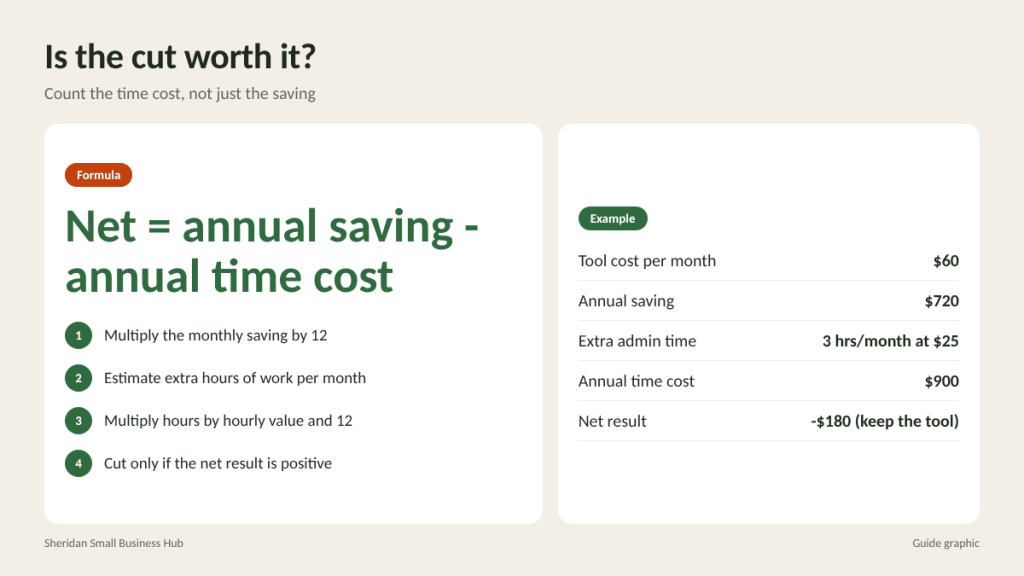
Not every saving is worth having. A cut that saves $40 a month but costs an employee two extra hours of work a week is a loss. Before you cut, ask four questions:
- What does it save per year? Multiply the monthly figure by 12 so small amounts are not dismissed or overrated.
- What does it cost in time? Estimate the extra hours per month and multiply by a reasonable hourly value for whoever absorbs the work.
- Will customers notice? Anything that slows responses, delays orders or makes your business look less professional needs extra scrutiny.
- Is it reversible? Canceling a tool you can restart is low risk. Giving up a prime office location usually is not.
Here is a worked example. Suppose you drop a $60-per-month scheduling tool and handle bookings by email instead. That saves $60 x 12 = $720 a year. If the manual process adds 3 hours a month and you value admin time at $25 an hour, the hidden cost is 3 x $25 x 12 = $900 a year. The cut loses you $180 annually, so it is not worth making.
Step 5: Rethink how work gets done
Some of the biggest overhead savings come from changing processes rather than prices.
- Go lighter on paper. Scanning and digital storage reduce filing cabinets, storage space and time spent searching. Securely destroy what you no longer need to keep.
- Outsource irregular tasks. Notarizations, large print jobs, freight shipments and document shredding are tasks many small businesses need occasionally but not enough to justify equipment or training. Paying per use can beat owning.
- Batch errands. One weekly trip for supplies, shipping drop-offs and printing beats five scattered trips.
- Automate repetitive admin. Recurring invoices, payment reminders and bank feeds into your accounting software save hours every month.
Step 6: Keep overhead from creeping back
Overhead tends to return quietly. A few habits keep it in check:
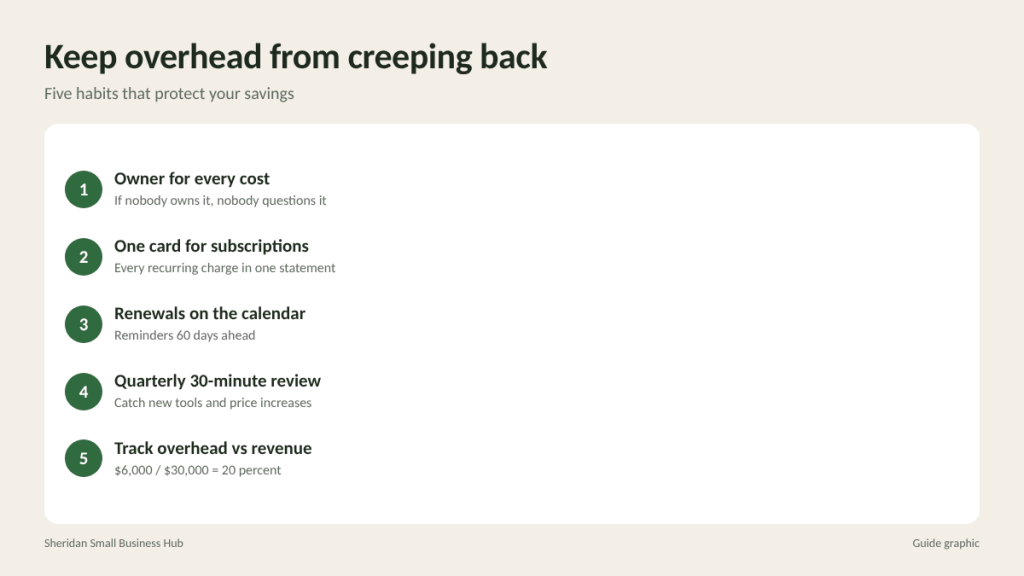
- Assign an owner to every recurring cost. If nobody owns it, nobody questions it.
- Use a single company card for subscriptions so every recurring charge appears in one statement.
- Put renewal dates on a calendar 60 days ahead, giving you time to compare options.
- Review the list every quarter. A 30-minute review catches new tools and price increases before they become permanent.
- Track overhead as a share of revenue. Divide total monthly overhead by monthly revenue. If the percentage climbs for several months in a row, investigate.
For example, if your monthly overhead is $6,000 and revenue is $30,000, overhead is 6,000 / 30,000 = 20 percent of revenue. If revenue stays flat but overhead rises to $7,500, that share becomes 25 percent, a clear signal to review. There is no single right percentage for every industry, so watch your own trend over time rather than comparing yourself with a generic benchmark.
Common mistakes when cutting costs
- Cutting marketing first. It feels optional, but it often drives future revenue. Trim waste within marketing rather than shutting it off.
- Buying cheap equipment that fails. A bargain printer or chair that breaks within a year costs more than a reliable one.
- Across-the-board percentage cuts. Asking every area to cut by the same amount ignores where the real waste sits.
- Ignoring security. Skipping safe disposal of old records or devices can expose customer data and lead to far bigger costs than you saved.
Frequently asked questions
How often should I review overhead costs?
Do a full 12-month review once a year and a shorter check every quarter. The quarterly check should focus on new recurring charges, price increases and upcoming renewals.
What is usually the fastest overhead cost to reduce?
Software subscriptions and unused services, because you can usually cancel or downgrade them in minutes without affecting customers.
Is it cheaper to outsource printing or own a large printer?
It depends on volume. If you print large or specialty jobs only occasionally, outsourcing usually costs less than buying, servicing and supplying a machine that sits idle.
Should I cut staff to reduce overhead?
Treat it as a last resort. Review subscriptions, supplies, leases and processes first, since losing experienced people often slows the business and raises hidden costs.
Stocking up without overspending?
Buying supplies as you need them, close to your office, keeps rush orders and storage costs down. The Postal Spot carries office supplies in Houston alongside printing and shipping, so one stop covers several errands.