
For a small online store, shipping is never just a back-office task. It shapes whether shoppers finish checkout, how much profit each order leaves you, how many reviews mention “arrived broken” and how many hours you spend at a packing table instead of growing the business. Many sellers make shipping decisions one at a time, as problems appear, and end up with a patchwork of rates, boxes and habits that nobody planned.
This guide helps you build an ecommerce shipping strategy from the ground up. It covers the decisions that matter most, in the order to make them: your customer promise, what you charge, which carriers and services to use, how you package orders, how packages get from your door to the carrier, how you handle problems and returns, and how to review the whole system as you grow.

What a shipping strategy actually covers
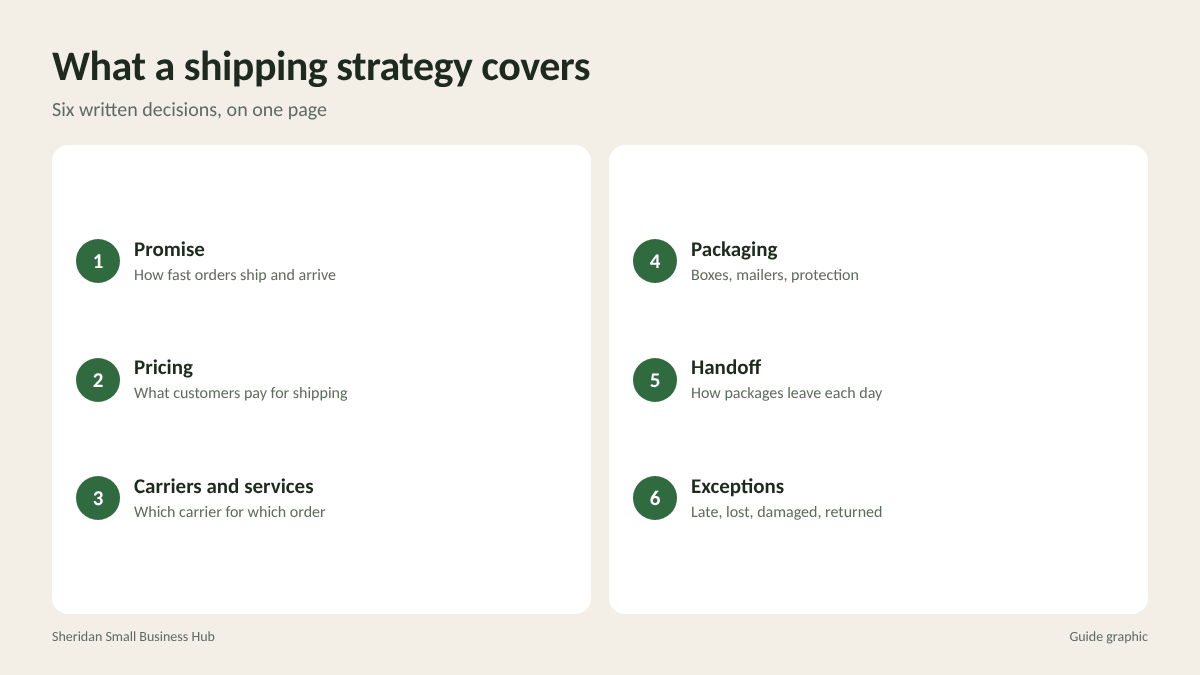
A shipping strategy is a short set of written decisions that answer six questions:
- Promise: How fast will orders ship and arrive?
- Pricing: What will customers pay for shipping, if anything?
- Carriers and services: Which carriers and service levels will you use for which orders?
- Packaging: Which boxes and mailers, and how will items be protected?
- Handoff: How do packages leave your business each day?
- Exceptions: What happens when packages are late, lost, damaged or returned?
Writing these down, even on one page, keeps decisions consistent and makes it easier to train help later. It also gives you a baseline to compare against when you test a change.
Step 1: Define your customer promise
Your promise has two parts: handling time (how long between order and shipment) and transit time (how long the carrier takes). Customers experience the total.
- Set a handling time you can hit every day, including busy weeks. Shipping within one business day is a strong promise for many small stores; two days may be more realistic if you make items to order.
- Set a daily order cutoff, such as orders placed by a certain time ship the same day, and display it clearly.
- Show estimated delivery ranges rather than exact dates unless your platform calculates them reliably.
- Under-promise slightly. Packages that arrive early earn goodwill; packages that arrive late earn support emails.
Step 2: Decide what customers pay
There are four common models, and many stores mix them:
- Free shipping on everything: Simple and attractive, but the cost must be built into product prices.
- Free shipping over a threshold: Encourages larger orders while protecting margins on small ones.
- Flat rate: One predictable price per order, easy to communicate. You win on some orders and lose on others.
- Real-time calculated rates: Customers pay what the carrier charges for their address and package. Accurate, but sometimes surprising at checkout.
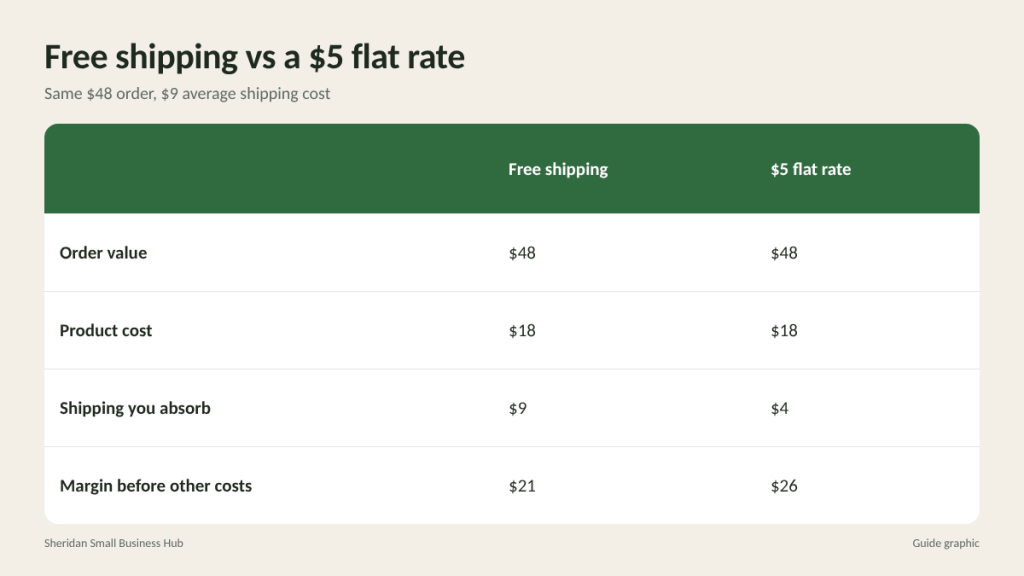
Whatever you choose, test the numbers. Worked example: your average order is $48, your product cost is $18 and your average shipping cost is $9. If you offer free shipping, your remaining margin per order before other costs is 48 – 18 – 9 = $21. If you charge a $5 flat rate instead, the shipping cost you absorb drops to 9 – 5 = $4, and your margin becomes 48 – 18 – 4 = $26. Whether the extra $5 per order is worth possible lost sales is the trade-off you are weighing.
Step 3: Choose carriers and service levels
No single carrier is cheapest for every package. Rates depend on weight, dimensions, distance and service level.
- Light, small packages: USPS Ground Advantage is often competitive for lightweight parcels.
- Heavier or larger boxes: FedEx Ground and UPS Ground are often worth comparing as weight and size grow.
- Urgent orders: Offer an expedited or overnight option at checkout for customers willing to pay for speed.
- Dimensional weight: FedEx and UPS use a divisor of 139 to calculate dimensional weight on published rates, and USPS uses 139 for packages over 1 cubic foot. A box that is too large for its contents can cost more than a heavier, smaller one.
Use shipping software that compares rates across carriers and prints labels in batches. Then set default rules, such as “under 1 lb goes by the cheapest ground option,” so you are not deciding each order from scratch.
Step 4: Standardize your packaging
Packaging affects cost, damage rates and how customers feel when they open the box.
- Stock a small set of sizes that fit your most common orders snugly.
- Use poly mailers for soft, unbreakable items and boxes for anything that can crush or break.
- Match cushioning to fragility, and leave enough space around delicate items so they do not touch the box walls.
- Write a packing standard for each product: box size, cushioning and any insert. Anyone helping you can follow it.
- Add a branded touch, such as a thank you card or a sticker, if it fits your brand and budget.
Step 5: Plan the daily handoff
The last step in your strategy is how packages physically leave your business. Choose based on volume and routine.
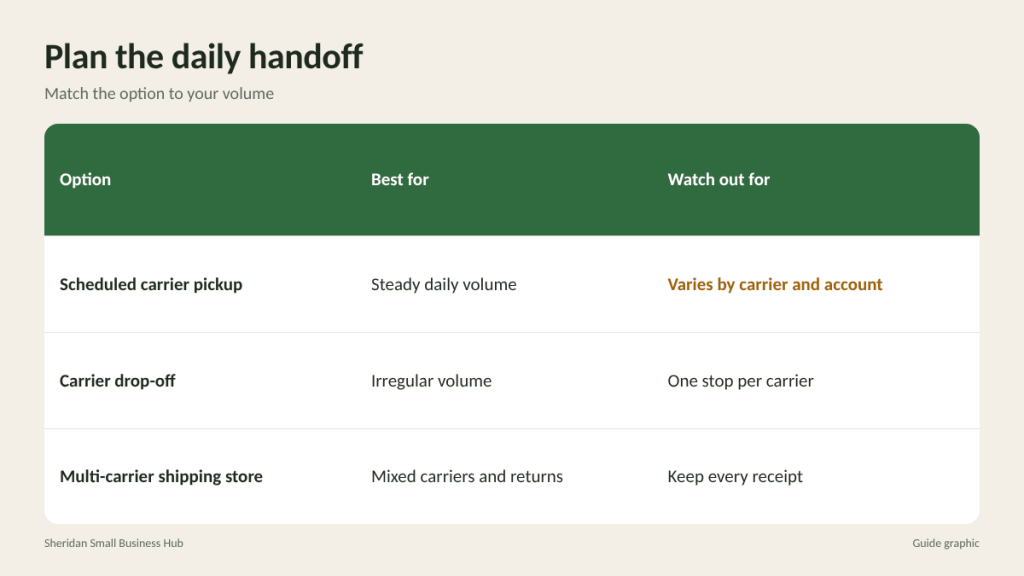
- Scheduled carrier pickups work well for steady daily volume with one main carrier.
- Carrier drop-off locations suit irregular volume, but multiple carriers can mean multiple stops.
- A local multi-carrier shipping store lets you drop prepaid FedEx, UPS and USPS packages, plus returns, in one trip and get receipts as proof of handoff.
Batch your handoff. One trip at a set time, timed to your order cutoff, is far more efficient than several trips a day. Always keep drop-off receipts or scan confirmations until each package shows delivered.
Step 6: Write your exception and returns playbook
Problems are inevitable. Deciding in advance keeps responses fast and consistent.
- Late packages: Check tracking, contact the customer proactively and set a point at which you treat a package as lost.
- Lost packages: Decide when you will reship or refund, and file carrier claims where coverage applies.
- Damaged items: Ask for photos of the item and the packaging, and keep packaging records to support any claim.
- Returns: State your return window, condition requirements and who pays return shipping. Make return labels easy to get.
- Address errors: Use address validation at checkout to catch typos before they become problems.
Publish the customer-facing parts in a clear shipping and returns policy, linked from your checkout and product pages.
Step 7: Review your numbers quarterly
Every three months, pull a report and look at:
- Average shipping cost per order, and as a share of order value
- Percentage of orders shipped within your promised handling time
- Damage, loss and return rates by product
- Which box sizes trigger dimensional weight charges
- Customer comments about shipping in reviews and emails
Also revisit your strategy whenever something big changes: you add a heavy or fragile product line, a carrier announces new rates or surcharges, your order volume doubles, or you start selling on a new marketplace with its own delivery requirements. Each of these can shift which carrier, box or pricing model makes the most sense. Keep your one-page strategy document updated so that the written version always matches what actually happens at your packing table.
Small adjustments, such as a smaller box for a bestseller or a new carrier for heavy orders, add up quickly over hundreds of shipments.
Frequently asked questions
Should a small store offer free shipping?
Only if your margins can absorb it or your prices include it. A free shipping threshold is often a good middle ground.
Is it better to use one carrier or several?
Several, if your software makes comparison easy. Different carriers are often cheaper for different weights, sizes and distances.
How fast should I ship orders?
Choose a handling time you can meet every day, including busy periods, and display it clearly. Consistency matters more than speed alone.
How do I prove I shipped a package?
Keep drop-off receipts or acceptance scans, and save tracking numbers with each order until delivery is confirmed.
Want a faster daily handoff?
Drop all your prepaid labels in one stop. Package drop-offs at The Postal Spot in Houston accept FedEx, UPS and USPS shipments, plus Amazon returns, with a receipt for your records.