
Most small businesses do not have a marketing budget. They have marketing expenses: a boosted post here, a box of flyers there, a sponsorship someone asked for at the last minute. Without a plan, money goes to whatever feels urgent, and it is almost impossible to tell what is actually bringing in customers. A budget does not have to be large to be useful. It just has to be deliberate.
This guide walks you through building a small business marketing budget step by step: how to decide how much to spend, how to split it across channels, how to plan for the year, and how to track results so next year’s budget is smarter than this one. You will also find a worked example you can adapt to your own numbers.
Step 1: Know your numbers before you set a budget
A marketing budget should connect to the economics of your business. Gather these figures first:
- Revenue: Last year’s total and this year’s target.
- Gross margin: What is left from each sale after the direct cost of the product or service.
- Average sale value: The typical amount a customer spends per purchase.
- Customer lifetime value: Roughly how much a customer spends with you over the whole relationship. A rough estimate is average sale value x purchases per year x years they stay.
- Current marketing spend: Add up everything spent last year on ads, printing, sponsorships, software and freelancers, even if it was never called marketing.
Lifetime value tells you how much you can reasonably spend to win a customer. If a customer is worth $600 in gross profit over three years, spending $40 to attract them can be a very good trade. If they are worth $50, it is not.
Step 2: Decide how much to spend
There are three common ways to set the total.
Percentage of revenue
Set aside a fixed share of current or target revenue. This is simple and keeps spending tied to the size of the business. The right percentage varies a lot by industry, growth stage and margins, so treat any figure you read as a starting point, not a rule. New businesses trying to build awareness often spend a larger share than established ones with steady referrals.
Goal-based budgeting
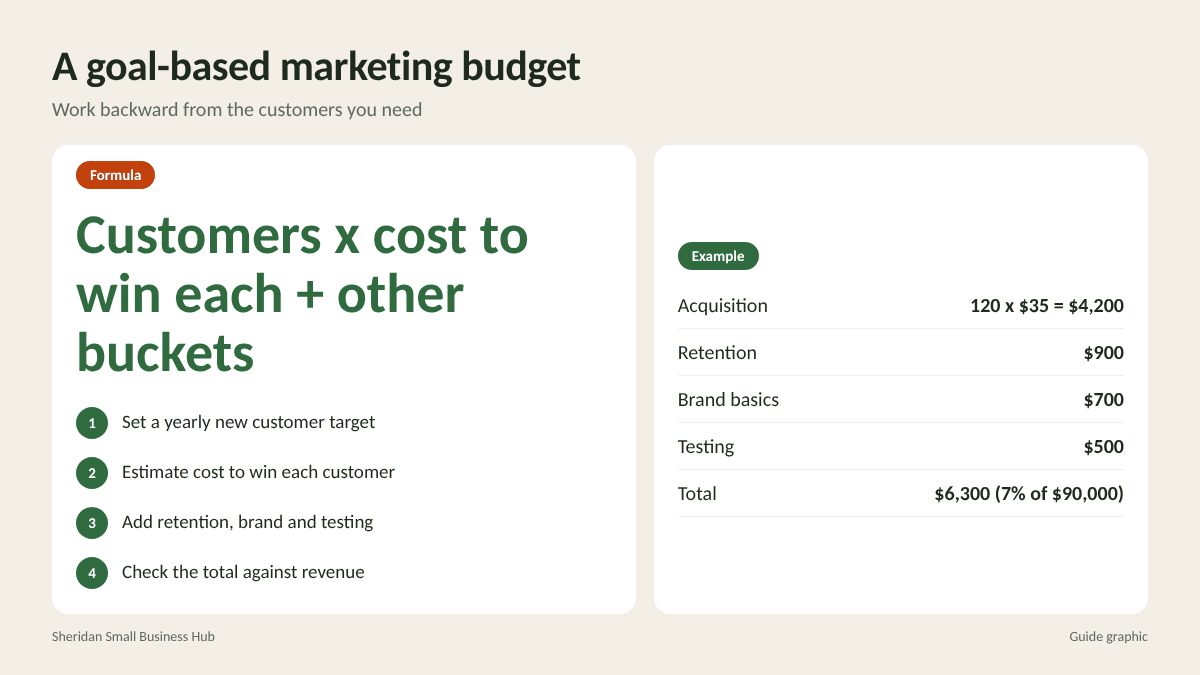
Work backward from a target. Decide how many new customers you need, estimate what each one costs to acquire, and multiply. This method forces you to think about results instead of activity.
What you can afford
Sometimes the honest answer is a fixed amount that will not strain cash flow. That is fine, as long as you spend it on the channels most likely to work and track the results closely.
Many owners use a blend: a goal-based estimate checked against a percentage of revenue and a firm affordability ceiling.
Step 3: A worked goal-based example
Suppose a local service business wants 120 new customers next year. From past experience, the owner estimates it costs about $35 in marketing to win each new customer through a mix of local ads and printed mailers.
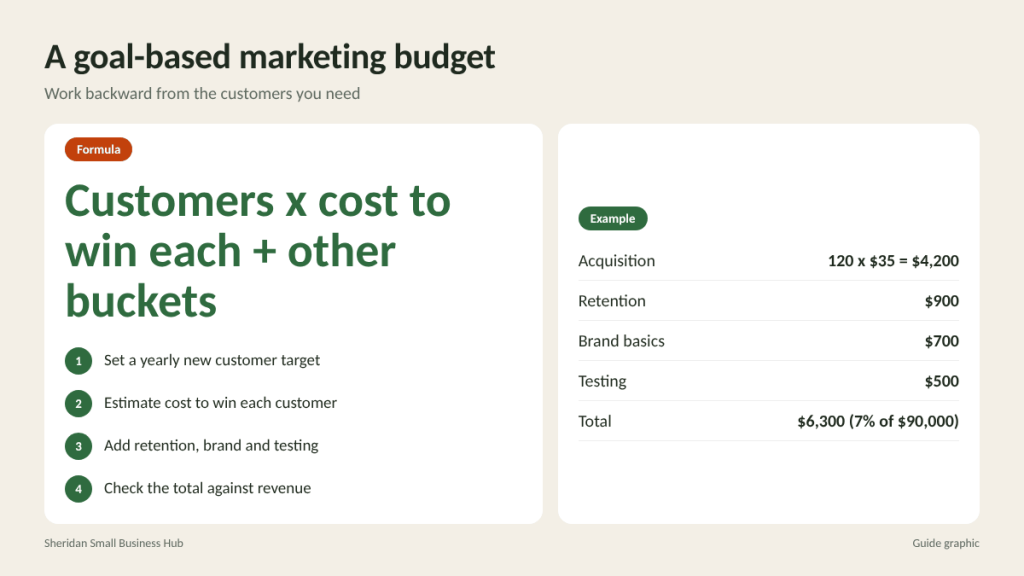
- Acquisition budget: 120 x $35 = $4,200
- Retention and repeat business (email tool, loyalty cards, thank you cards): $900
- Brand basics (website hosting, business cards, signage refresh): $700
- Testing new ideas: $500
- Total: $4,200 + $900 + $700 + $500 = $6,300 for the year, or about $525 a month
If the business expects $90,000 in revenue, that is 6,300 / 90,000 = 7 percent of revenue. The owner can then decide whether that share fits the margins and cash flow, and adjust the customer target or channel mix if it does not.
Step 4: Split the budget across channels
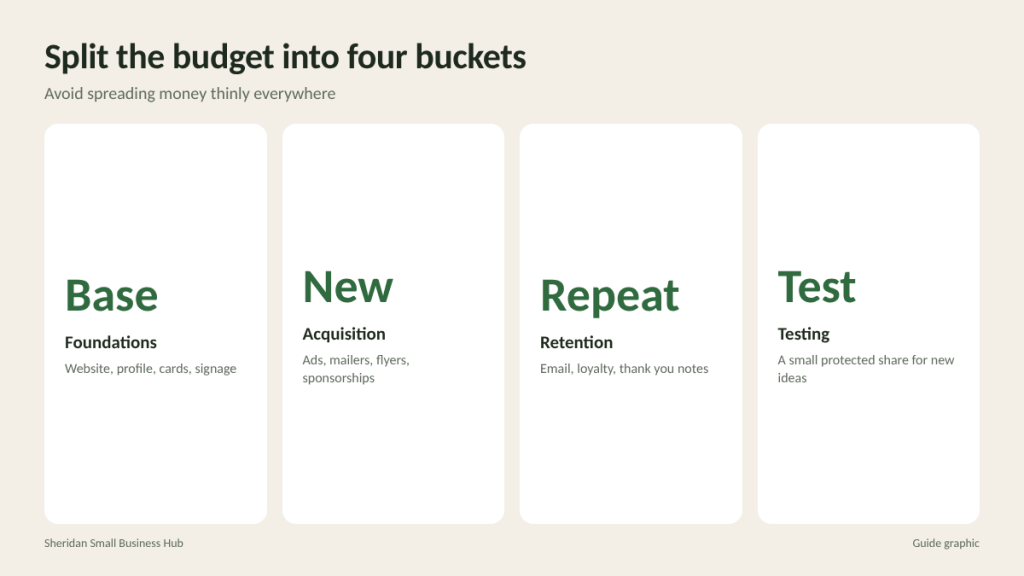
Rather than spreading money thinly across everything, group spending into a few buckets.
- Foundations: Website, Google Business Profile upkeep, logo and brand materials, business cards and basic signage. These support every other channel.
- Acquisition: Paid search and social ads, direct mail postcards, flyers, local sponsorships, event booths and directory listings that bring in new people.
- Retention: Email newsletters, loyalty programs, thank you notes and follow-up offers that bring existing customers back. Keeping a customer usually costs less than finding a new one.
- Testing: A small, protected share for trying something new, such as a different ad platform, a new print format or a partnership.
Put the most money into the channels that have already produced customers for you. If you have no history, start with the channels where your customers clearly spend time, and plan to shift money after three months of data.
Step 5: Build a 12-month calendar
Spending the same amount every month ignores how your business actually works. Map your budget against the calendar:
- Mark your busy and slow seasons using last year’s sales by month.
- Plan campaigns ahead of busy periods, not during them. Printed pieces and ads need time to be designed, produced and seen.
- Add fixed dates: holidays, local events, school calendars, your anniversary and any trade shows.
- Schedule production deadlines for print materials at least two to three weeks before they are needed.
- Leave a small reserve for unexpected opportunities, such as a last-minute event spot.
Step 6: Track every dollar and every result
A budget only gets better if you can see what worked. Use a simple spreadsheet with one row per campaign and these columns: channel, dates, cost, leads or responses, new customers and revenue from those customers.
Make tracking possible from the start:
- Use a unique discount code or QR link for each printed piece and each ad.
- Ask every new customer how they heard about you, and record the answer.
- Use tagged links on digital campaigns so your website analytics show the source.
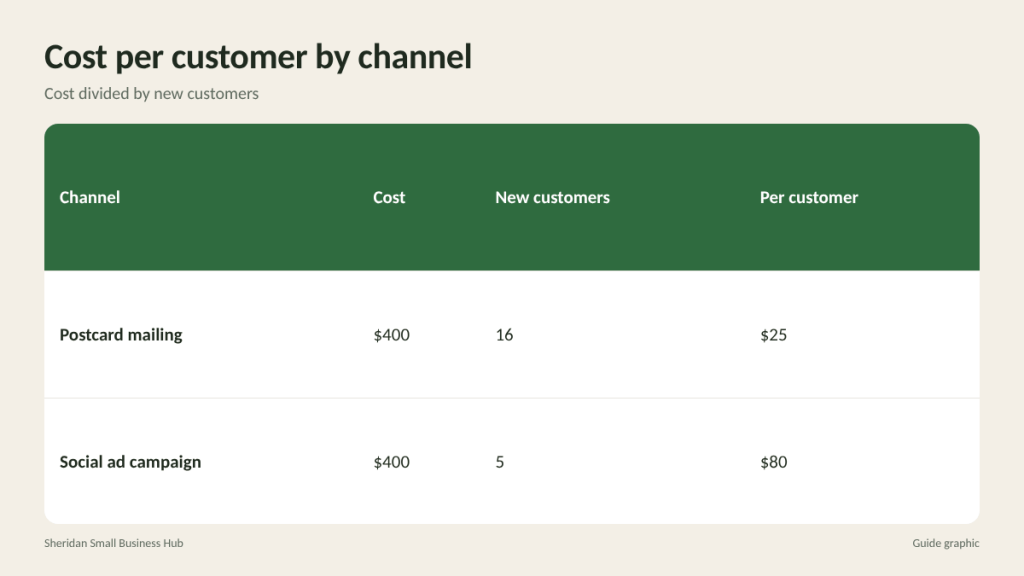
Then calculate cost per customer for each channel: cost divided by new customers. If a postcard mailing costs $400 and brings 16 new customers, that is 400 / 16 = $25 per customer. If a social ad campaign costs $400 and brings 5, that is $80 per customer. Unless the ad customers spend much more, the postcards deserve more of next quarter’s budget.
Step 7: Review quarterly and adjust
Every three months, sit down with your tracking sheet and ask:
- Which channels produced customers at an acceptable cost?
- Which channels produced activity (likes, views) but no customers?
- Did any test deserve a bigger share?
- Are we on pace with the yearly customer target?
Move money from weak channels to strong ones gradually. A single bad month is not always a verdict, but three months of poor results usually is.
Common budgeting mistakes
- Cutting marketing entirely in slow months, which often makes the next slow month worse.
- Forgetting production costs, like design, printing and shipping of materials.
- Chasing every new platform instead of mastering a few channels.
- Not counting your own time. Hours spent managing ads or posting have real value.
- Judging channels by vanity metrics. Views, likes and impressions are useful signals, but customers and revenue are what pay the bills.
- Spending the whole budget early. Front-loading everything into the first quarter leaves nothing for the busy season or a promising test that deserves more fuel.
- No written plan. A one-page budget shared with anyone who spends money keeps everyone working toward the same goal.
Frequently asked questions
How much should a small business spend on marketing?
There is no single right number. Base it on how many customers you need, what each one costs to win and what your margins and cash flow can support, then adjust based on results.
Should a new business spend more on marketing?
Often yes, because a new business has no referrals or reputation yet. Build in a plan to reduce acquisition spending as repeat customers grow.
Is print marketing worth including in a small budget?
For local businesses, often yes. Printed pieces are easy to target to a neighborhood and easy to track with codes or QR links.
How do I track marketing results without expensive software?
A spreadsheet, unique codes for each campaign and asking every new customer how they found you will cover most small businesses.
Putting part of your budget into print?
Keep production simple by printing close to home. The Postal Spot prints posters, banners, flyers and copies in Houston, so your campaign materials are ready when your calendar says go.