
Office supplies rarely feel like a big expense. A box of pens here, a toner cartridge there, a case of paper when someone remembers. But because those purchases are small and scattered across receipts, card statements and petty cash, many owners have no idea what they actually spend in a year. Setting an office supply budget small business owners can stick to turns that fog into a number you can plan around and trim.
This guide shows you how to find your real baseline spending, build a monthly budget by category, set simple purchasing rules, and track the results without adding much admin work. You will also see a worked example you can copy with your own numbers.
Why supply spending drifts without a budget
Supply costs creep for predictable reasons. Several people buy on their own cards. Purchases happen in a hurry, at convenience prices. Nobody checks what is already in the closet, so duplicates pile up. And because each purchase is small, none of them gets a second look.
A budget does not need to be strict to help. Simply setting a monthly number and assigning one person to watch it usually changes behavior. People pause before buying the premium pens, ask whether there are folders in the closet, and group purchases into one order.
Step 1: Find your real baseline
Before you set a budget, find out what you spend now. Pull the last 6 to 12 months of:
- Business credit and debit card statements
- Receipts from office supply stores and online orders
- Petty cash logs
- Employee expense reimbursements
- Any supply items billed through vendors, such as toner on a printer lease
Sort each purchase into a category and add them up. Divide the total by the number of months to get a monthly average. If you only have 3 months of good records, that is still a starting point; just plan to revisit the budget sooner.
Step 2: Break spending into categories
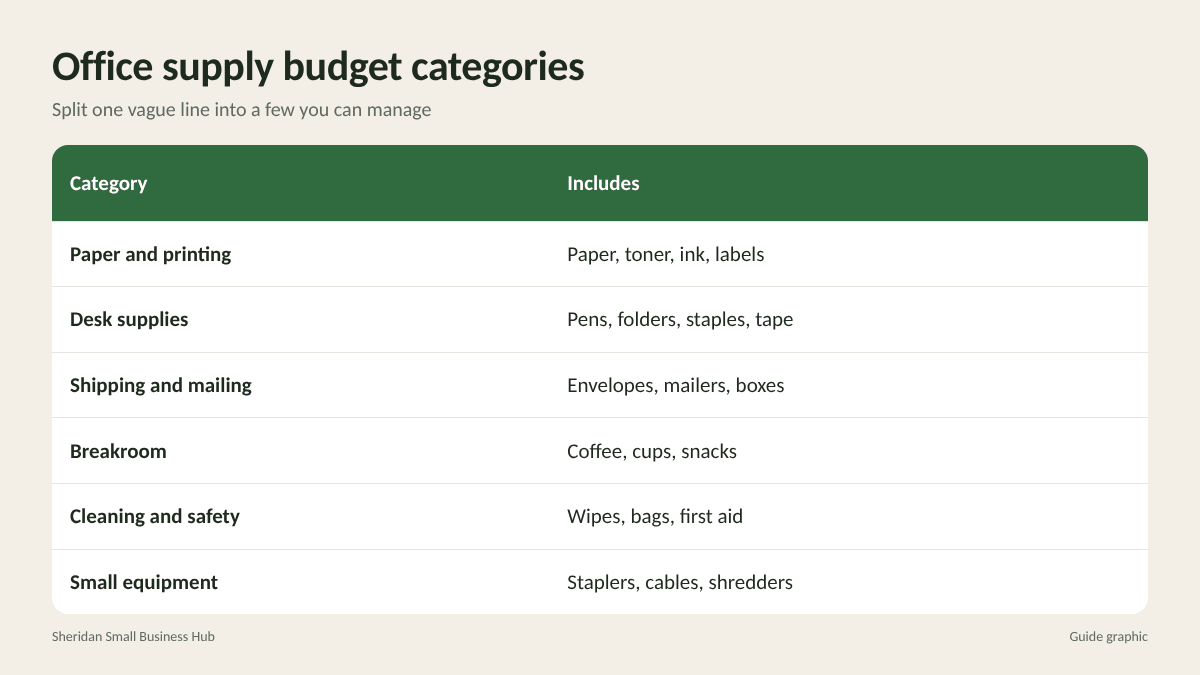
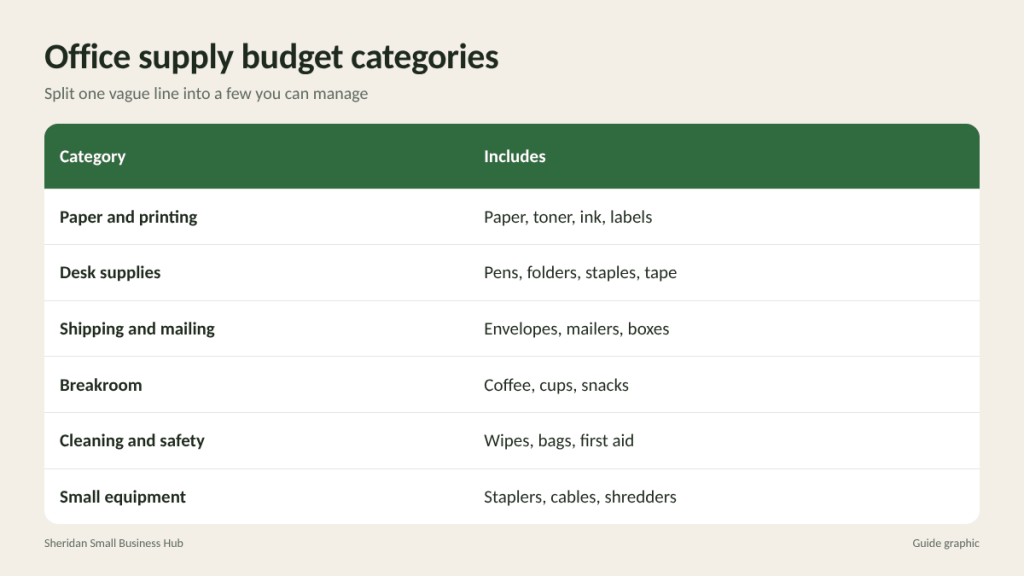
A single “supplies” line hides where the money goes. Use a handful of categories that match how your office works:
- Paper and printing: copy paper, toner, ink, specialty paper, labels
- Desk supplies: pens, notepads, sticky notes, folders, staples, tape
- Shipping and mailing: envelopes, mailers, boxes, packing tape, postage
- Breakroom: coffee, water, cups, snacks, paper towels
- Cleaning and safety: wipes, trash bags, hand soap, first aid refills
- Small equipment: calculators, staplers, desk organizers, shredders, cables
Most offices find that one or two categories, often printing and breakroom, make up a large share of the total. Those are where savings efforts pay off first.
Step 3: Build an office supply budget small business teams can follow
Once you know your baseline by category, set a monthly target for each. A practical method:
- Start with your monthly average for each category.
- Adjust for known changes, such as a new hire, a busy season or a planned move to digital invoices.
- Set a modest reduction target on the biggest categories, based on specific changes you will make, not a wish.
- Add a small buffer for unexpected needs, so one surprise purchase does not break the budget.
A worked example
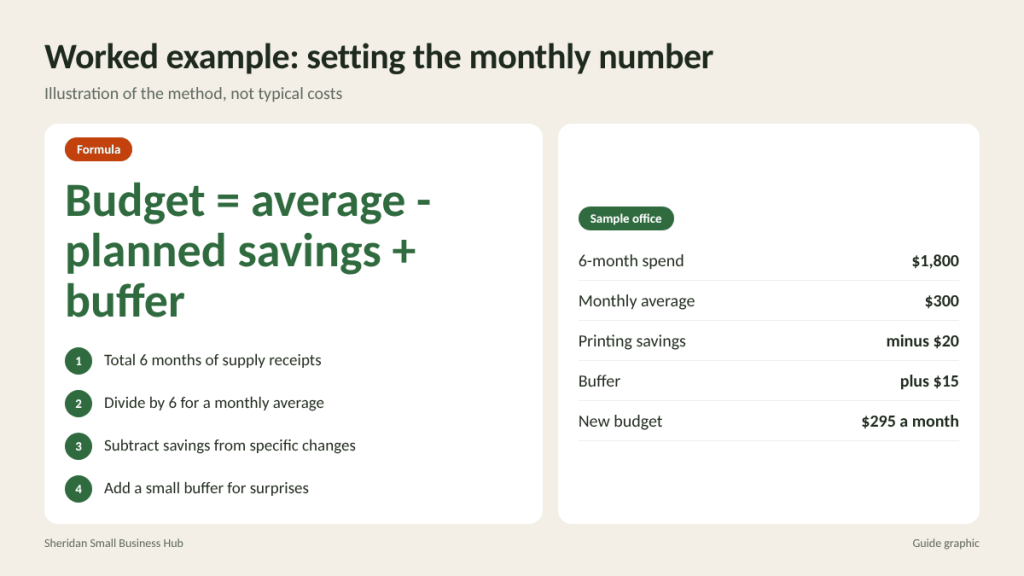
Here is a sample office that pulled six months of records and found it spent $1,800 on supplies in that period. That is $1,800 / 6 = $300 a month. Broken down by category:
- Paper and printing: $120 a month
- Desk supplies: $45 a month
- Shipping and mailing: $60 a month
- Breakroom: $55 a month
- Cleaning: $20 a month
Those add up to $120 + $45 + $60 + $55 + $20 = $300. The owner decides to set duplex (double-sided) printing as the default on every printer and email invoices instead of mailing them, and aims to cut printing by $20 a month. That brings the printing line to $100. Adding a $15 monthly buffer gives a new total of $300 – $20 + $15 = $295 a month, or $3,540 a year.
Your numbers will differ. These figures are only an illustration of the method, not typical costs.
Step 4: Set purchasing rules everyone understands
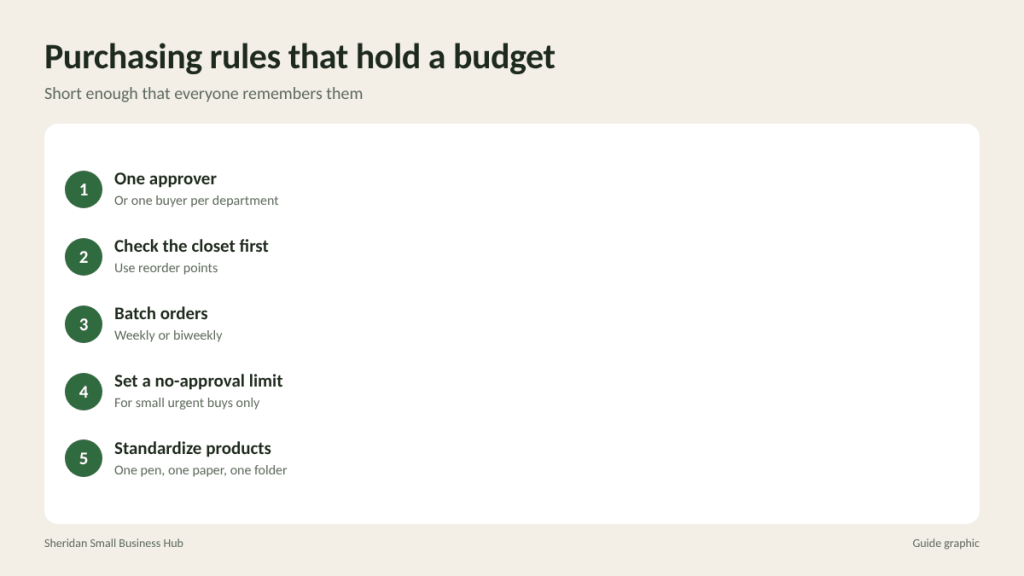
A budget only holds if the buying process supports it. Keep the rules short:
- One person approves supply orders, or each department has one buyer.
- Check the closet first. Use a simple inventory list with reorder points so people know what is on hand.
- Batch purchases into a weekly or biweekly order instead of daily one-off buys.
- Set a spending limit for purchases without approval, such as anything under a small amount for urgent needs.
- Agree on standard products. Choose one brand and type of pen, paper and folder so you can buy in quantity and compare prices easily.
Step 5: Find savings without making work harder
Cutting supplies too hard frustrates staff and can cost more in lost time. Focus on changes that reduce waste rather than comfort:
- Print less. Default to duplex and grayscale, and share documents digitally when you can.
- Buy consumables in sensible quantities. A case of paper is usually cheaper per ream than single reams, but a year’s supply of anything that dries out, such as ink or markers, is not a bargain.
- Match the printer to the job. For large or color runs, outsourcing to a print shop can be cheaper than burning through office toner.
- Right-size shipping supplies. Keeping a few box and mailer sizes reduces waste and filler costs.
- Track the breakroom separately. It is easy for snack and coffee costs to grow unnoticed.
Step 6: Track monthly and review quarterly
Tracking does not need special software. A spreadsheet with one row per purchase (date, vendor, category, amount) and a summary tab showing budget versus actual for each category is enough. Many accounting tools can also tag expenses by category automatically.
Each month, spend ten minutes comparing actual spending to the budget. Each quarter, ask three questions:
- Which categories ran over, and was there a good reason?
- Did any savings changes actually work?
- Does the budget need to change because the business changed?
If you consistently come in under budget in a category, lower it. If you are always over, find out why before raising it.
Supplies vs equipment: where to draw the line
One common source of budget confusion is mixing everyday supplies with equipment. A box of pens and a new printer are both “office stuff,” but they behave very differently in your books and your planning. Keep these separate:
- Consumables are used up and reordered regularly: paper, toner, tape, coffee, cleaning products. These belong in the monthly supply budget.
- Small equipment lasts a while but is inexpensive: staplers, desk organizers, calculators, a small shredder. A modest line in the supply budget usually covers these.
- Larger equipment and furniture lasts years: printers, computers, desks and chairs. Plan for these in a separate equipment or capital budget, and ask your accountant how they should be recorded for tax purposes.
Keeping them apart also makes trends clearer. If your supply line jumps one month because someone bought a new monitor, you lose the ability to see whether paper and toner use is actually going up. When in doubt, ask yourself whether you expect to buy the item again within a year. If yes, it is a supply. If not, it probably belongs in the equipment plan.
Frequently asked questions
How much should a small business spend on office supplies?
There is no universal figure; it depends on headcount, industry and how much you print and ship. Your own past 6 to 12 months of spending is the most reliable starting point.
Should office supplies be a separate budget line?
Yes. Separating supplies from equipment and software makes it much easier to see trends and spot waste.
What is the easiest way to cut supply costs?
Reduce printing, standardize products and batch purchases. These three changes rarely affect how people work.
How often should I review the supply budget?
Check actual against budget monthly, and revisit the targets themselves every quarter or after big changes such as new hires.
Keeping supply runs efficient?
For the items you need on hand quickly, office supplies in Houston from The Postal Spot make it easy to restock locally without waiting on a delivery.