
If you sell more than a handful of products, you have probably stood in front of a stack of boxes wondering which one to use. Too big, and you pay to ship air and fill the gap with packing material. Too small, and the corners crush or the product scuffs in transit. Figuring out what size box to ship products in is not a one-time guess; it is a small system you build once around your actual catalog.
This guide walks you through measuring your products, adding the right amount of cushioning, grouping items into a short list of standard box sizes, and checking each size against dimensional weight pricing so you do not get surprised on your invoice. By the end you will have a box chart your whole team can follow.
Why box size affects your shipping cost as much as weight
Carriers price packages on whichever is greater: the actual weight or the dimensional (DIM) weight. DIM weight reflects how much space a package takes up on a truck or plane. FedEx and UPS use a divisor of 139 for their published daily rates on all package sizes. USPS also uses 139 (it changed from 166 on July 12, 2026), but only for packages larger than 1 cubic foot (1,728 cubic inches), and Flat Rate products are exempt.
The formula is:
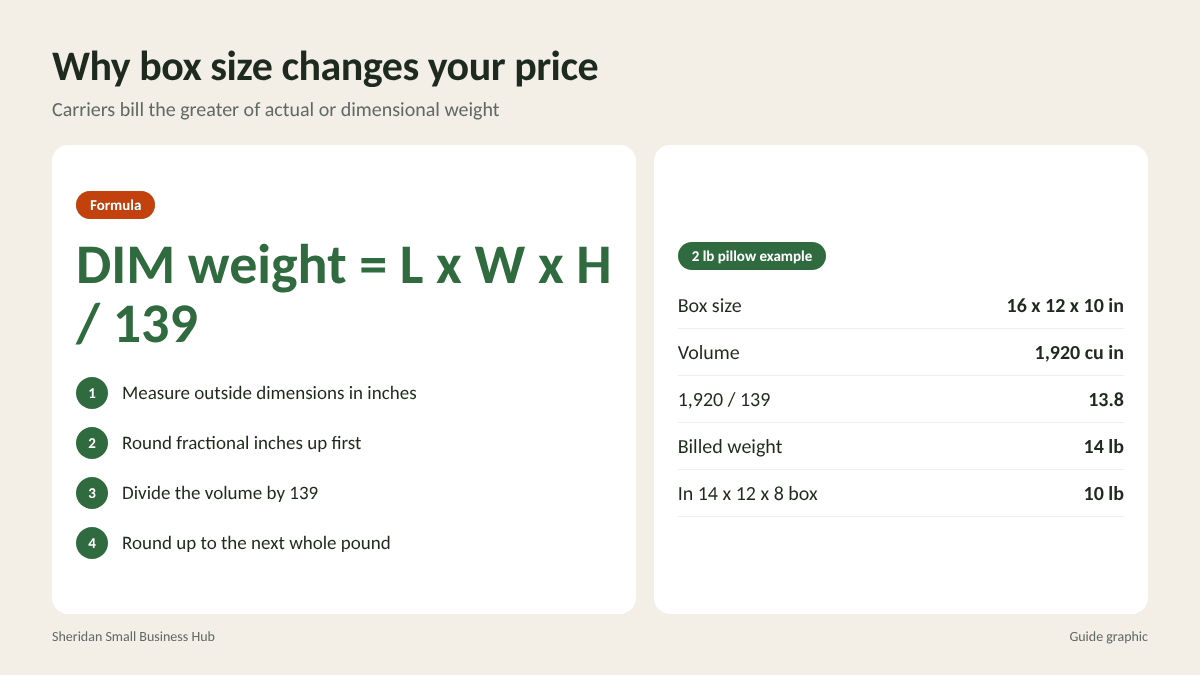
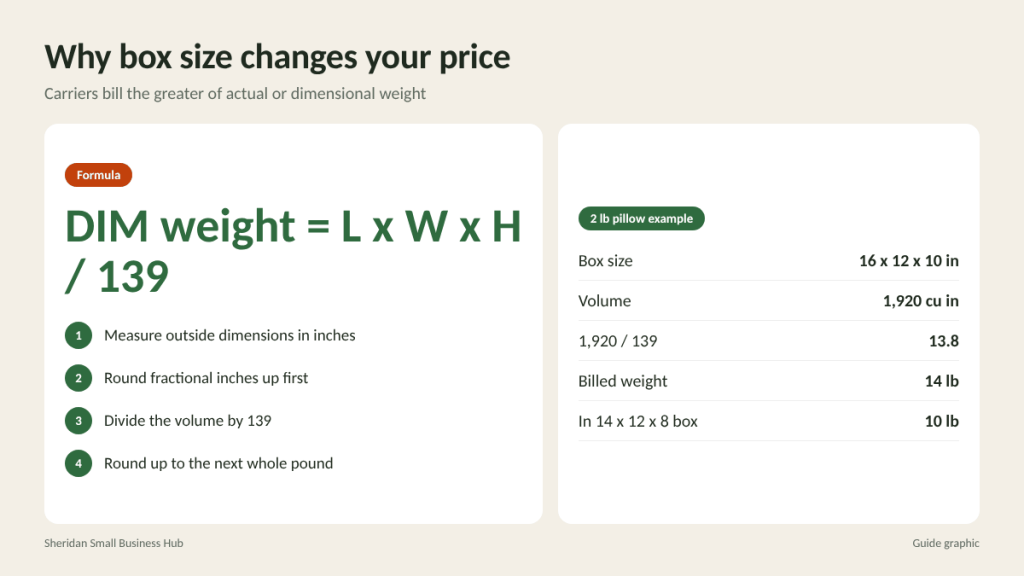
DIM weight = length x width x height (in inches) / 139, rounded up to the next pound, with fractional inches rounded up first.
Here is why it matters. A pillow weighing 2 pounds in a 16 x 12 x 10 inch box has a volume of 1,920 cubic inches. Divided by 139, that is about 13.8, which rounds up to 14 pounds. You would be billed for 14 pounds, not 2. Drop to a 14 x 12 x 8 inch box (1,344 cubic inches) and the DIM weight becomes about 9.7, rounding up to 10 pounds. Same product, 4 billable pounds saved on every shipment.
Step 1: Measure every product the right way
Start with a list of everything you sell, including common bundles. For each, record:
- Length, width and height of the item in its retail packaging, measured at the widest points. Include handles, spouts and anything that sticks out.
- Weight on a digital scale.
- Fragility: rigid and durable, moderately fragile, or very fragile.
- Shape: flat, cube-like, long and thin, or irregular.
Round each measurement up to the next quarter inch. A spreadsheet works well here; one row per product or bundle.
Step 2: Add the right amount of cushioning
The inside of the box needs to be larger than the product by enough room for protection. A common guideline used across the industry is about 2 inches of cushioning on every side for fragile items. That means adding 4 inches to each dimension (2 inches on each side). For durable items, such as books or folded clothing, much less space is needed; often a snug fit with a little paper fill is enough, or a poly mailer instead of a box.
Example: a ceramic mug in a gift box measures 5 x 4 x 4 inches. With 2 inches of cushioning on all sides, the inside of the shipping box should be about 9 x 8 x 8 inches.
Remember that box sizes are usually listed by inside dimensions, while carriers measure the outside. Corrugated walls add a little, so measure a sample of each box you plan to stock.
What size box to ship products in: building a short standard list
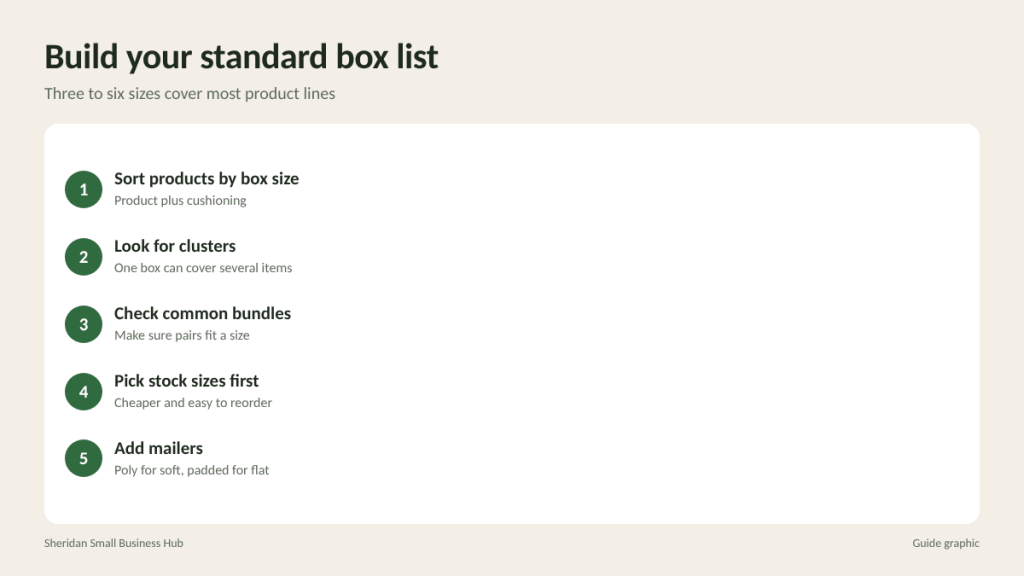
The goal is not a perfect box for every product. It is a short list, usually three to six sizes, that covers most of your orders well. Here is how to build it:
- Sort your product list by the required inside box size (product plus cushioning).
- Look for clusters. If a dozen products need something between 8 x 6 x 4 and 9 x 7 x 5, one 9 x 7 x 5 box can cover them all.
- Check your most common multi-item orders. If customers often buy two candles together, make sure one of your sizes fits a pair.
- Pick standard stock sizes from suppliers rather than custom sizes at first. They are cheaper and easy to reorder.
- Add mailers for soft goods (poly mailers) and flat items (padded or rigid mailers). They often replace a box entirely.
Then create a box chart: a simple table that says “Product A: Box 2, 1 sheet of bubble wrap” and “Product A x 2: Box 3.” Post it at your packing station so nobody has to guess.
Step 3: Test each size against DIM weight
Before you buy boxes in bulk, run each standard size through the DIM formula and compare it with the typical actual weight of what goes inside.
- If actual weight is higher than DIM weight, box size has little effect on price, so prioritize protection.
- If DIM weight is much higher than actual weight, you are shipping air. Look for a box that is an inch or two smaller in one dimension.
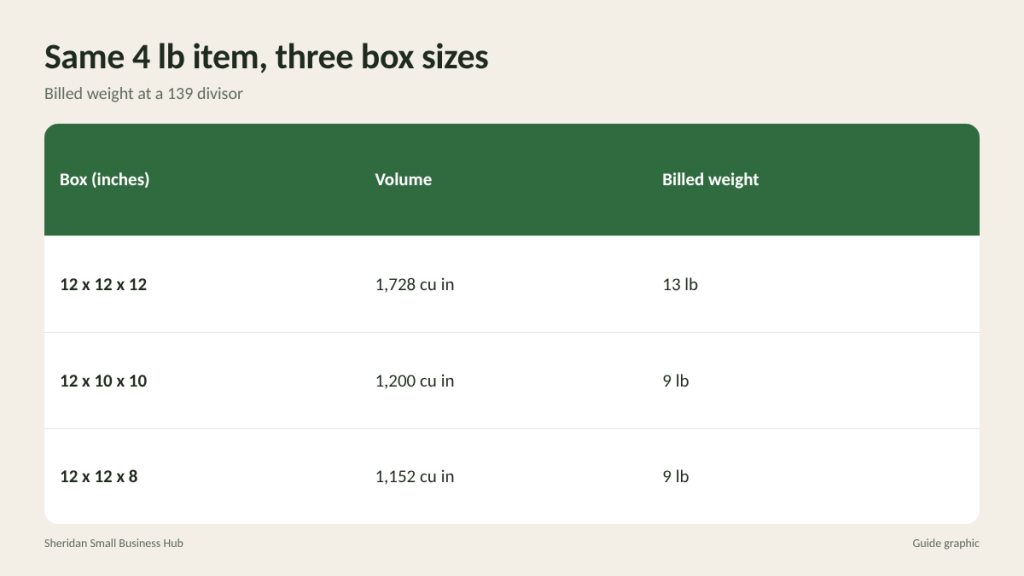
Example: a 12 x 12 x 12 box is 1,728 cubic inches. At a 139 divisor that is 12.4, which rounds up to 13 pounds. If what you put in it usually weighs 4 pounds, try a 12 x 10 x 10 box (1,200 cubic inches, DIM weight 8.6, billed as 9 pounds) or a 12 x 12 x 8 box (1,152 cubic inches, about 8.3, billed as 9 pounds).
Small changes to the height dimension often make the biggest difference, because many products are wide but not tall.
Step 4: Stay within parcel limits
Large boxes can push you into oversize charges or past carrier limits. For FedEx and UPS, a single package can weigh up to 150 pounds, with a maximum length of 108 inches and a maximum of 165 inches in length plus girth. USPS allows up to 70 pounds and 130 inches in length plus girth. Girth is twice the width plus twice the height. Anything near those limits deserves its own pricing check, and carriers apply extra handling charges on large or heavy packages well before you reach the maximum.
Mistakes to avoid when choosing boxes
- Using one big box for everything. It feels simpler but costs more in DIM weight and void fill.
- Reusing worn boxes for heavy items. Each trip weakens corrugated board. Old boxes are fine for light, durable products if all old labels are removed or covered.
- Ignoring box strength. Heavier items need stronger board. Many boxes have a manufacturer’s stamp on the bottom flap showing their rated strength.
- Forgetting the unboxing. A tightly fitted box with neat fill looks more professional than a large box full of loose peanuts.
- Never revisiting the list. Review your box chart whenever you add products or every few months.
Frequently asked questions
How much space should I leave around a product in a box?
For fragile items, about 2 inches of cushioning on every side is a common guideline. Durable items can fit more snugly with minimal fill.
How many box sizes should a small business stock?
Three to six sizes plus a couple of mailer types cover most product lines. Track usage for a month and adjust.
Is dimensional weight the same for every carrier?
FedEx and UPS apply a 139 divisor to all packages on daily rates. USPS uses 139 only for packages over 1 cubic foot, and Flat Rate is exempt.
Are custom-sized boxes worth it?
They can be for a high-volume best seller, but start with stock sizes. Move to custom once you know exactly which product ships most often.
Not sure which box fits?
Bring an awkward item to The Postal Spot, a UPS Authorized Shipping Outlet in Houston, and get help packing it and comparing options before it ships.