
Your shipping policy is one of the least exciting pages on your website and one of the most important. Shoppers check it before they buy, customer service relies on it when an order is late, and payment processors and marketplaces may look for it when there is a dispute. A vague or missing policy leads to “where is my order?” emails, chargebacks and lost trust. A clear one, built from a solid shipping policy template ecommerce stores can adapt, answers questions before customers have to ask.
This guide covers every section a good shipping policy should include, explains what to write in each, and ends with a fill-in-the-blanks template you can adapt for your store. It also flags the most common mistakes, like promising delivery dates you cannot control.
Why your shipping policy matters
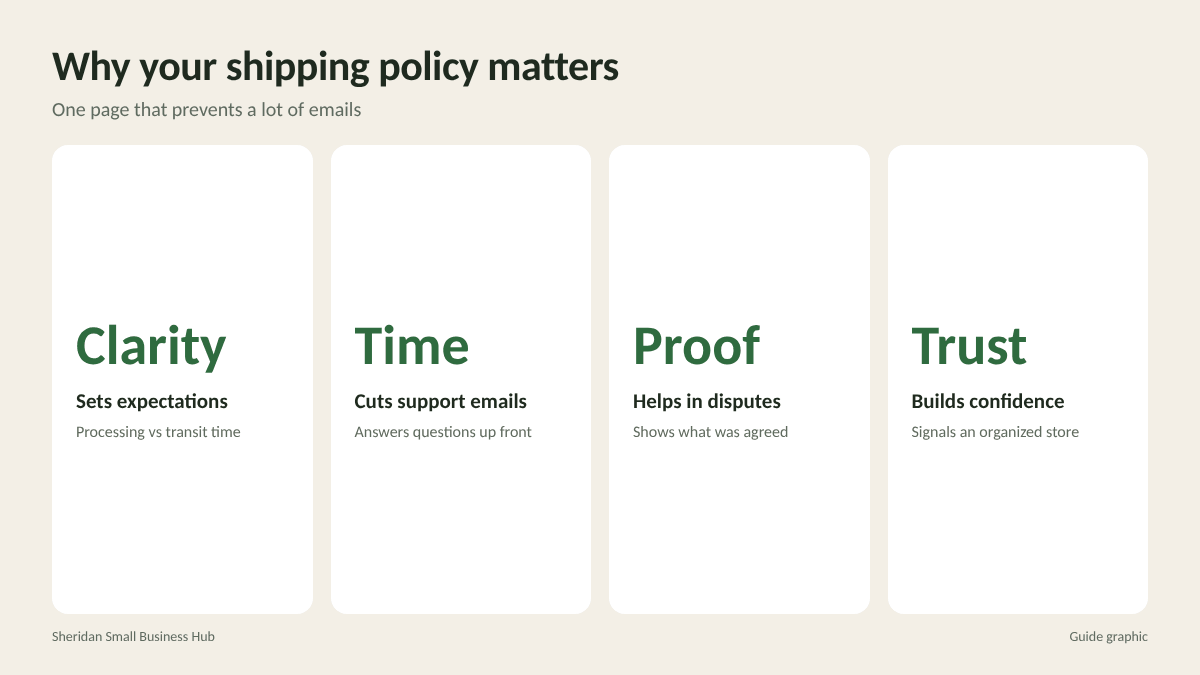
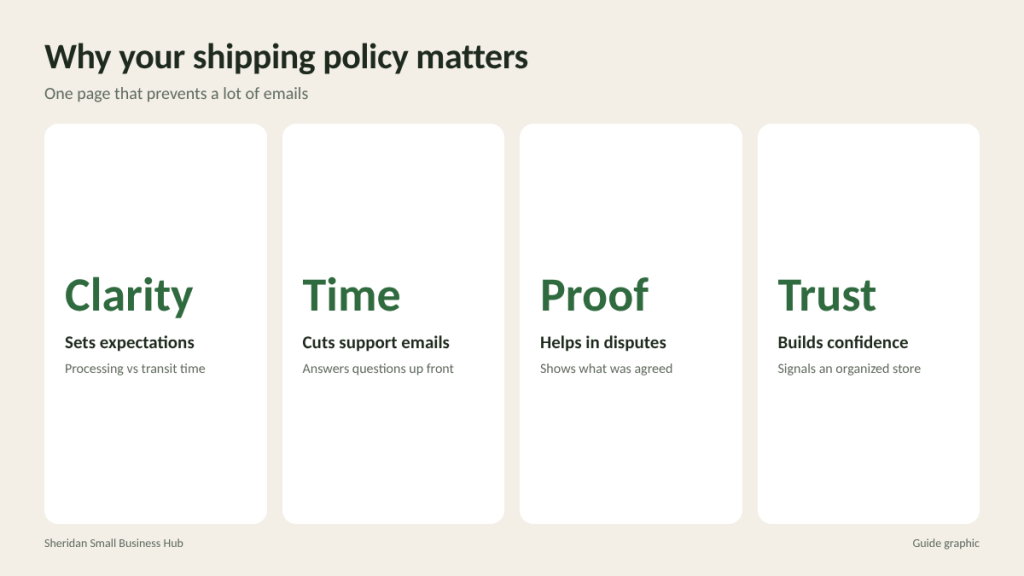
- It sets expectations. Customers who know that orders ship in 1 to 2 business days and arrive in 3 to 5 are far less likely to complain on day four.
- It reduces support time. A clear page answers the questions you would otherwise answer one email at a time.
- It protects you in disputes. When a customer claims a package never arrived, a published policy about tracking, delivery confirmation and lost packages shows what was agreed.
- It builds confidence. A detailed policy signals a real, organized business, which matters most for new or smaller stores.
The sections every shipping policy should include
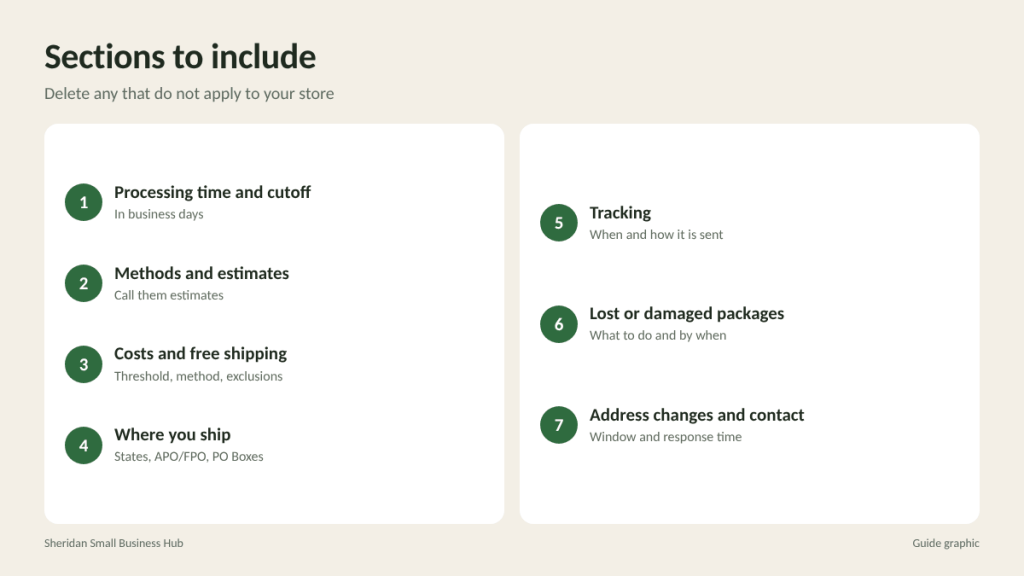
1. Order processing time
This is how long it takes you to prepare an order before it is handed to the carrier, and it is separate from transit time. State it in business days and give a daily cutoff time, for example: “Orders placed by 1 p.m. Central Time Monday through Friday ship the same business day.” Mention whether you ship on weekends or holidays.
2. Shipping methods and estimated delivery times
List each option you offer, such as standard, expedited and overnight, with the carrier if you want to specify it and an estimated transit time in business days. Always call these estimates. Carriers control transit, and weather or volume can cause delays.
3. Shipping costs
Explain how shipping is charged: flat rate, calculated at checkout based on weight and destination, or free over a certain order value. If you offer a free shipping threshold, state the amount, which shipping method it covers and any excluded items or regions.
4. Where you ship
Say which destinations you serve: all 50 states, only the contiguous US, US territories, military APO/FPO addresses, PO Boxes or international. Many stores have different rules for Alaska, Hawaii and territories because of cost and transit time. Note that FedEx and UPS generally cannot deliver to a standard PO Box, so if you ship with them, say whether customers need a street address.
5. International shipping (if you offer it)
List the countries or regions you ship to, and state clearly that customers are responsible for any import duties, taxes and customs fees charged by the destination country, unless you collect them at checkout. Mention that customs can add time to delivery.
6. Order tracking
Explain when and how customers receive tracking information, for example: “You will receive an email with a tracking number once your order ships.” Tell them where to look if they do not see it, such as their spam folder or their account page.
7. Lost, stolen or damaged packages
This section prevents the most disputes. Explain:
- What to do if tracking shows delivered but the package is missing (check with neighbors and building staff, wait a set number of days, then contact you).
- How soon to report damage, and that they should keep the box and packaging and send photos.
- Whether you file carrier claims, reship or refund, and under what conditions.
- Whether you offer or require shipping insurance or signature confirmation for higher-value orders.
8. Incorrect addresses
State that customers are responsible for entering a correct address, explain how to request a change (and the window to do so before the order ships), and say what happens if a package is returned because of an address error, such as reshipping for an additional fee.
9. Delays and peak seasons
Mention that processing and transit can take longer during holidays, sales events and severe weather, and point to any holiday cutoff dates you publish each year.
10. Contact information
End with how to reach you about a shipping question: email, phone, contact form and your expected response time.
A shipping policy template ecommerce stores can copy
Replace the bracketed sections with your own details and delete anything that does not apply.
Shipping Policy
Processing time: All orders are processed within [1 to 2] business days. Orders placed after [1 p.m. Central Time] or on weekends or holidays are processed the next business day.
Shipping options and delivery estimates: We offer [Standard: estimated 3 to 7 business days] and [Expedited: estimated 2 to 3 business days]. Delivery times are estimates provided by the carrier and are not guaranteed.
Shipping rates: Shipping charges are [calculated at checkout based on weight and destination / a flat rate of $X]. Orders over [$X] qualify for free [Standard] shipping within [the contiguous United States]. [Oversized items are excluded.]
Where we ship: We ship to [all 50 US states / the contiguous US], [and APO/FPO addresses]. [We do not currently ship internationally.] [Orders shipping by FedEx or UPS require a street address.]
Tracking: You will receive a shipping confirmation email with a tracking number once your order ships.
Lost or damaged packages: If tracking shows your order was delivered but you cannot find it, please check with neighbors and wait [2] business days, then contact us. If your order arrives damaged, email photos of the item and packaging within [7] days of delivery. We will work with you and the carrier to [replace or refund] your order.
Address changes: Contact us within [12 hours] of placing your order to change the address. Packages returned due to an incorrect address can be reshipped for an additional shipping charge.
Questions: Email [address] or call [phone]. We respond within [1 business day].
Common shipping policy mistakes
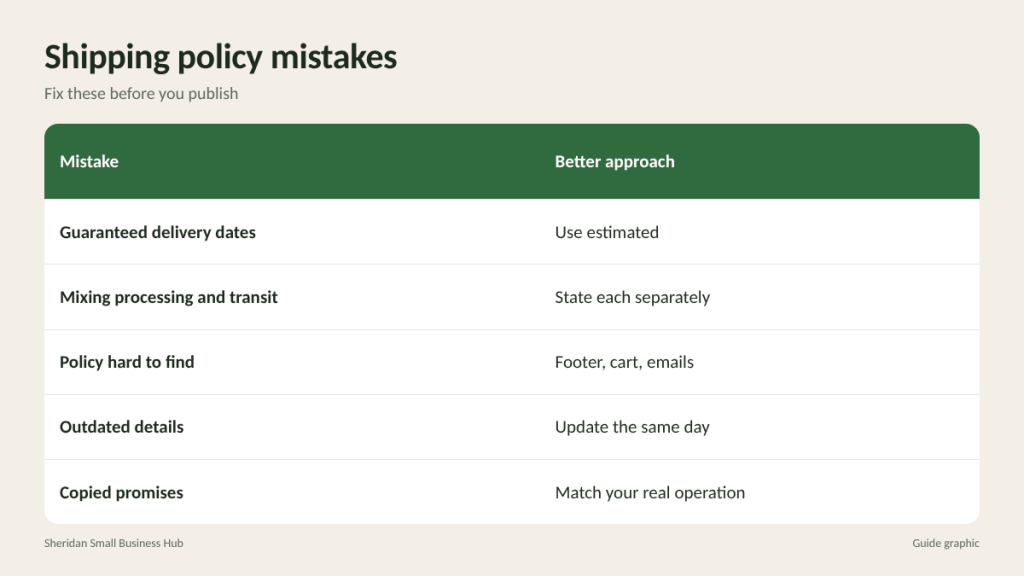
- Guaranteeing delivery dates you do not control. Use “estimated.”
- Mixing up processing and transit time, so customers think “3 to 5 days” includes packing when it does not.
- Burying the policy. Link it in your footer, product pages, cart and order confirmation emails.
- Letting it go stale. If you change carriers, cutoffs or thresholds, update the page the same day.
- Contradicting your checkout. If checkout says one thing and the policy says another, customers will hold you to the better one.
- Copying a competitor’s policy with promises your operation cannot keep.
Making sure your operation matches the policy
A policy only builds trust if you actually meet it. Before publishing, check your real numbers: how long does it take you to pack orders on a busy day? What time do packages actually leave your business? If you rely on carrier pickups or drop-offs, make sure your cutoff time leaves enough room to get packages to the carrier the same day. Build in a little cushion so normal busy days do not break your promise.
Frequently asked questions
Is a shipping policy legally required?
Requirements vary, but payment processors, marketplaces and consumer protection rules generally expect clear terms. Ask an attorney about your specific obligations.
Where should I put my shipping policy?
Link it in the site footer, on product pages, in the cart and in order confirmation emails.
Should I list carriers by name?
It is optional. Naming carriers sets clear expectations, but describing service levels gives you flexibility to switch.
How often should I update my shipping policy?
Whenever your carriers, cutoffs, rates or regions change, and before each holiday season.
Need a reliable same-day drop-off?
Help your processing time promise hold up with FedEx shipping at The Postal Spot in Houston, an authorized ShipCenter where you can drop off orders or get help packing them.