Opening a shop in Texas comes with plenty of good news, including no state personal income tax. But it also means you become a tax collector for the state. Every time you sell a taxable item, you are responsible for charging the right amount, keeping records and sending the money to the state on time. Mistakes are easy to make and can be costly to fix later. Getting Texas sales tax for small business right starts with a few basics: who needs a permit, what rate to charge, what is taxable and how filing works.
This guide covers those basics for local retail shops. It explains the state and local rates, the permit process, common taxable and exempt items, resale certificates, record keeping and filing. It is general information, not tax advice, and Texas rules have details and exceptions, so confirm specifics with the Texas Comptroller of Public Accounts or a tax professional.
Who needs to collect Texas sales tax
If you sell taxable goods or services in Texas, you generally need a Texas sales and use tax permit and must collect tax from your customers. That includes:
- Brick-and-mortar retail stores
- Online sellers based in Texas
- Vendors at markets, craft fairs and pop-up events
- Businesses that sell certain taxable services, which Texas defines specifically
You need a permit for each place of business where you sell. Apply through the Texas Comptroller’s website before you start making sales. Check the Comptroller’s site for current requirements, including whether a security deposit may apply.
Texas sales tax for small business: understanding the rates
Texas sales tax has two layers:
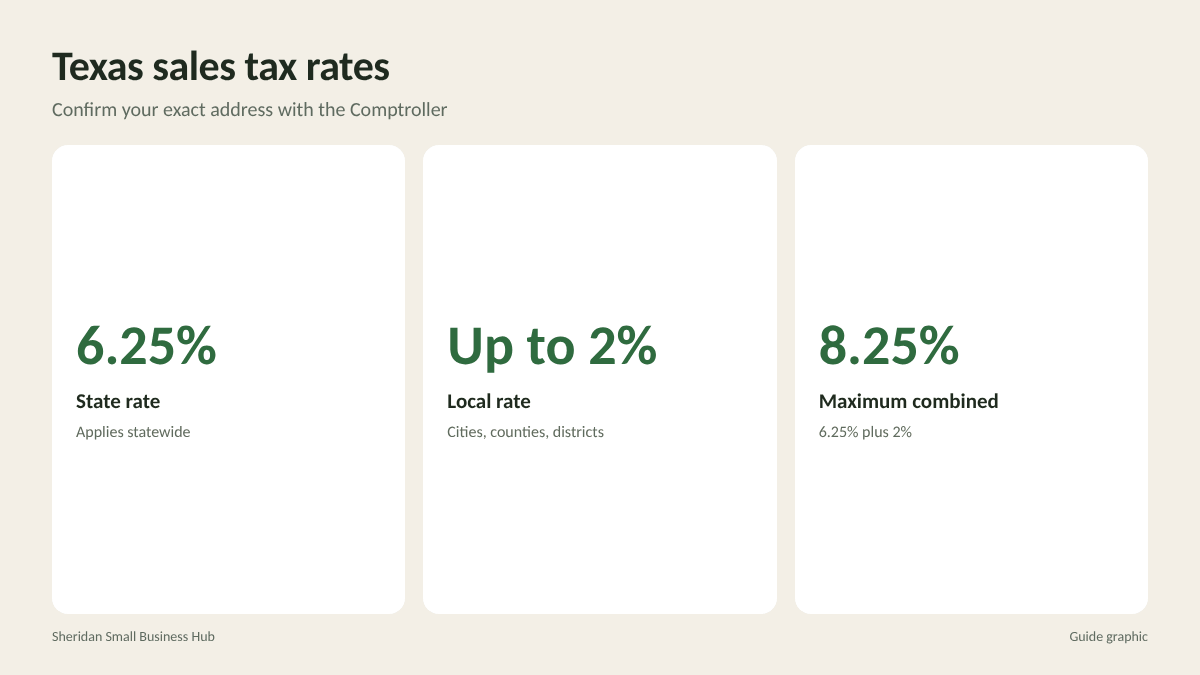
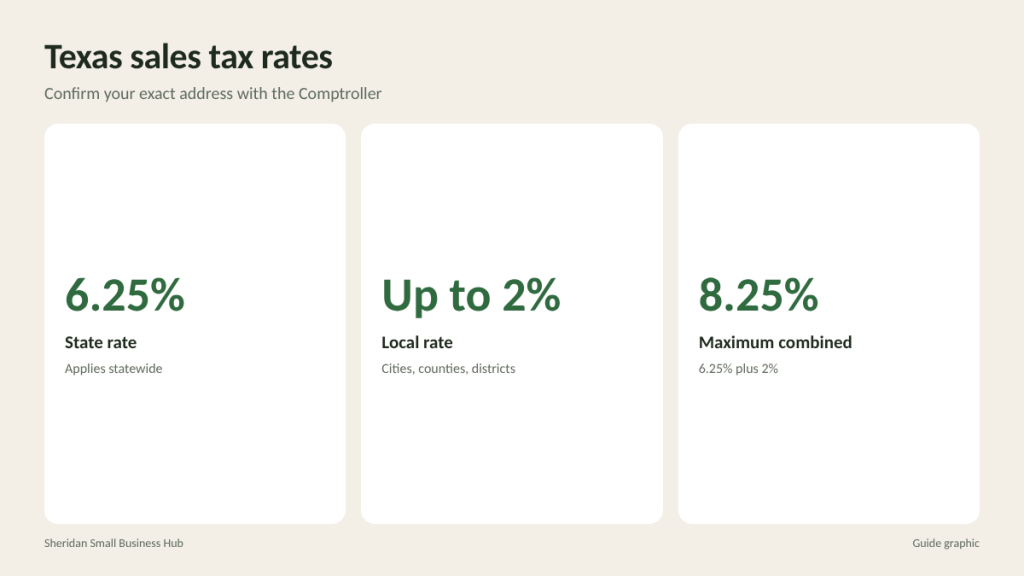
- State rate: 6.25%.
- Local rates: cities, counties, transit authorities and special purpose districts can add local sales tax, up to a combined local maximum of 2%.
That means the maximum combined rate in Texas is 6.25% + 2% = 8.25%. Many areas, including much of the Houston area, are at or near that maximum, but rates can differ even between nearby addresses because of special districts. The Comptroller offers a sales tax rate lookup tool by address; use it to confirm the rate for your exact location.
A worked example
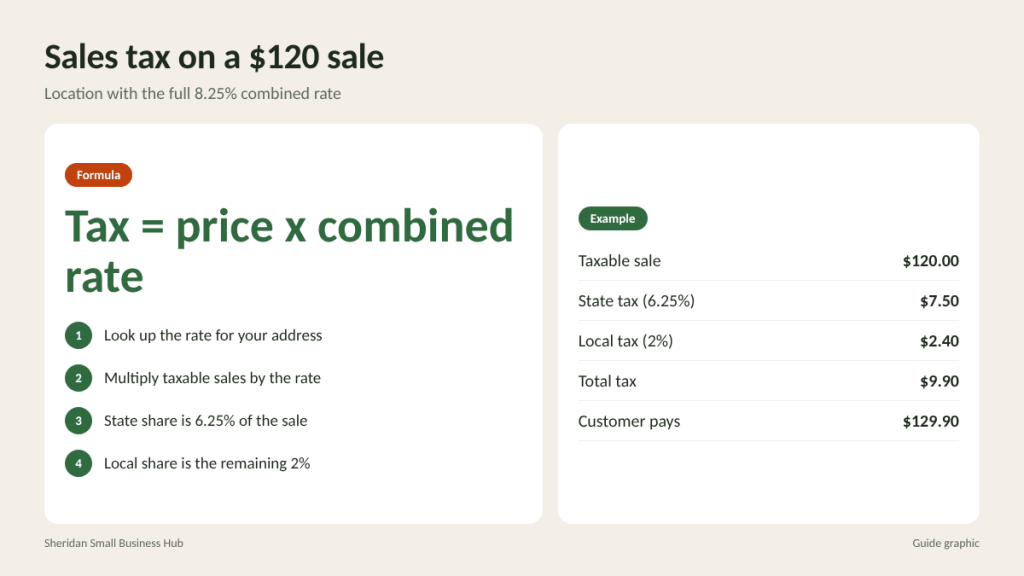
Your shop is in a location with the full 8.25% combined rate, and a customer buys $120 worth of taxable merchandise.
- Sales tax: $120 x 0.0825 = $9.90
- Total charged: $120 + $9.90 = $129.90
- Of the $9.90, the state portion is $120 x 0.0625 = $7.50, and the local portion is $120 x 0.02 = $2.40. ($7.50 + $2.40 = $9.90.)
Your point-of-sale system should calculate this automatically once it is set to the correct rate. Check it with a test sale.
Where the sale happens: local tax basics
For a Texas-based retailer selling in person, local tax is generally based on your place of business, where the customer takes the item. The rules for deliveries, out-of-town sales and online orders shipped within Texas have more detail. If you deliver or ship to customers in other cities, review the Comptroller’s guidance on local sales tax sourcing or ask your tax professional so you charge the right local rate.
What is taxable and what is not
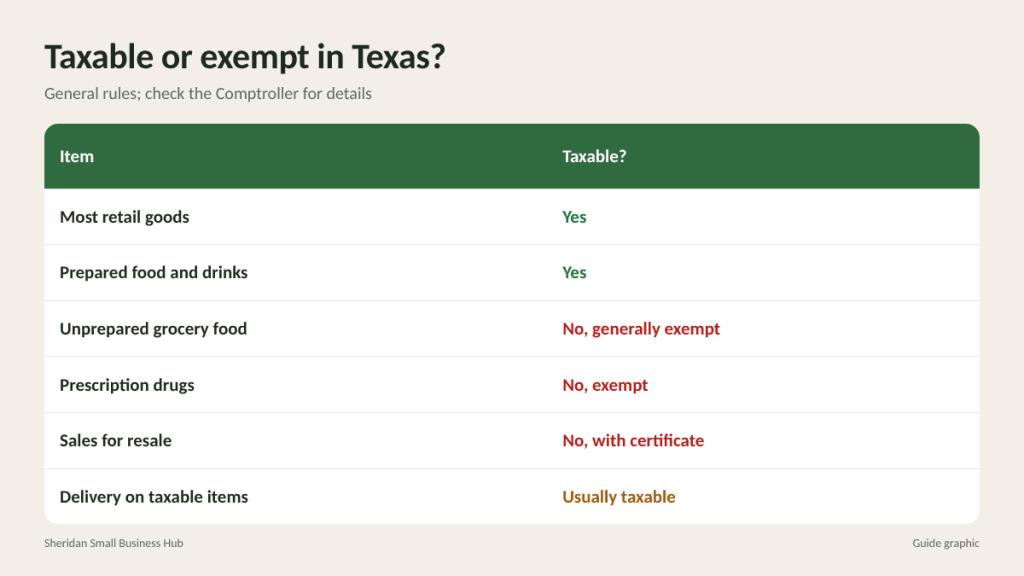
Generally taxable
- Most tangible goods: clothing, furniture, electronics, gifts, home goods, tools and similar items
- Prepared food and drinks sold by restaurants, cafes and food trucks
- Certain services that Texas specifically lists as taxable
- Delivery and handling charges connected to the sale of a taxable item are generally taxable too
Generally exempt
- Most grocery food items that are not prepared, such as bread, produce and milk
- Prescription drugs and certain over-the-counter drugs and medical items
- Items purchased for resale, when the buyer gives you a valid resale certificate
- Sales to qualifying exempt organizations that provide an exemption certificate
Texas also holds periodic sales tax holidays for specific categories of items. The Comptroller publishes the dates and qualifying items each year. If you sell eligible products, update your POS settings in advance.
Resale and exemption certificates
When another business buys from you to resell, it can give you a Texas resale certificate, and you do not collect tax on that sale. Likewise, qualifying nonprofits and government entities may give you an exemption certificate. Your responsibilities:
- Accept certificates in good faith and make sure they are filled out completely.
- Keep a copy on file for every exempt sale.
- Apply them only to qualifying purchases.
You can use a resale certificate yourself when buying inventory from suppliers, so you do not pay tax on goods you will resell. Items you buy for your own use, such as shelving, office supplies and cleaning products, are not purchased for resale and are generally taxable to you.
Filing and paying
When you receive your permit, the Comptroller assigns you a filing frequency, typically monthly, quarterly or yearly, based on how much tax you collect. A few key points:
- File every period, even if you had no sales. A missed “zero” return can still bring penalties.
- Check your due dates on the Comptroller’s site and put them on your calendar.
- File and pay online through the Comptroller’s system to keep confirmation records.
- Look into the timely filing discount the Comptroller offers for filing and paying on time, and check the current terms.
- Keep the tax separate. Sales tax you collect belongs to the state. Many owners move it into a separate account after each sales period so it is not spent by accident.
Setting aside tax as you go
A simple habit prevents a painful surprise at filing time. At the end of each week, take the taxable sales total from your POS report and multiply it by your combined rate. Move that amount into a separate savings account.
Example: a week with $4,000 in taxable sales at 8.25% means $4,000 x 0.0825 = $330 set aside. Over a four-week month, if every week is similar, that is $330 x 4 = $1,320 ready when your return is due. Your actual return will be based on your real totals for the period, but the reserve means the money is already there.
Check your POS setup
Most problems start in the register settings. Confirm that your POS uses the correct combined rate for your address, that exempt items such as unprepared grocery food are marked as non-taxable, that delivery charges on taxable items are taxed, and that tax-exempt customers can be flagged with their certificate on file. Review the settings whenever rates or your product mix change.
Records to keep
Good records make filing easy and protect you if the Comptroller audits your business:
- Daily sales reports from your POS, showing taxable and exempt sales separately
- Copies of all resale and exemption certificates
- Purchase invoices for inventory and for items you bought for your own use
- Copies of every sales tax return and payment confirmation
- Records of refunds and returns, which can reduce taxable sales
Ask your tax professional how long to retain sales tax records for your situation. When records have passed their retention period, shred anything with customer or financial details rather than putting it in the recycling.
Common mistakes to avoid
- Starting sales before getting a permit
- Using the wrong local rate for your address
- Forgetting to tax delivery charges on taxable items
- Accepting incomplete resale certificates or not keeping copies
- Skipping zero-sales returns
- Spending collected tax before it is paid
Frequently asked questions
What is the sales tax rate in Houston?
The Texas state rate is 6.25%, and local taxes can add up to 2%, for a maximum of 8.25%. Confirm your exact address with the Comptroller’s rate lookup.
Do I need a permit to sell at a weekend market?
Generally, yes, if you sell taxable items. Check the Comptroller’s guidance for temporary and event sales.
Do I charge sales tax on shipping fees?
In Texas, delivery charges tied to the sale of a taxable item are generally taxable as well.
What happens if I file late?
Late filing and payment can bring penalties and interest, and you may lose the timely filing discount.
Organizing your sales tax records?
Stock up on folders, binders and receipt paper at The Postal Spot, an office supply stop in Houston’s Uptown area, and keep every certificate and report in order.