
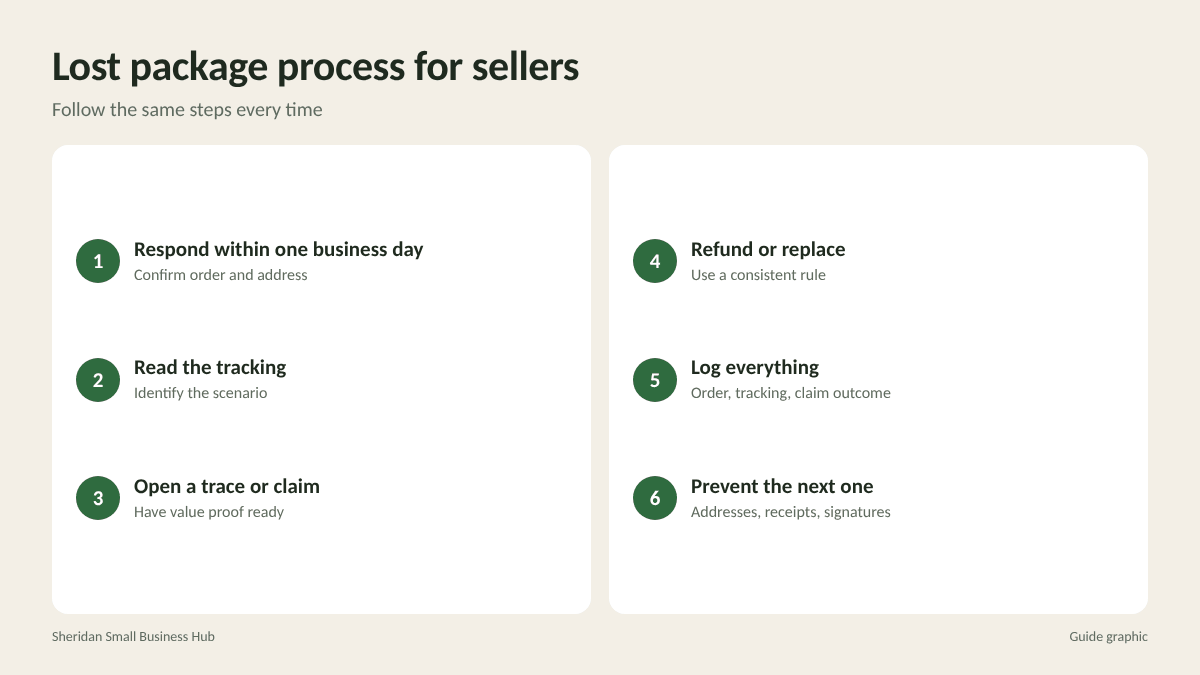
A customer emails: “My order never arrived.” Tracking says delivered, or it has not moved in a week. You want to keep the customer happy, avoid paying twice and not get burned by a chargeback. Without a clear answer to “what to do when customer package is lost,” every lost package becomes a stressful one-off that eats an hour and often ends with you refunding out of pocket.
This guide lays out the whole process step by step. It covers the first message to send, how to read tracking statuses, when to file a claim and with whom, how to decide between a refund and a replacement, and the changes that make the next lost package less likely and less costly.
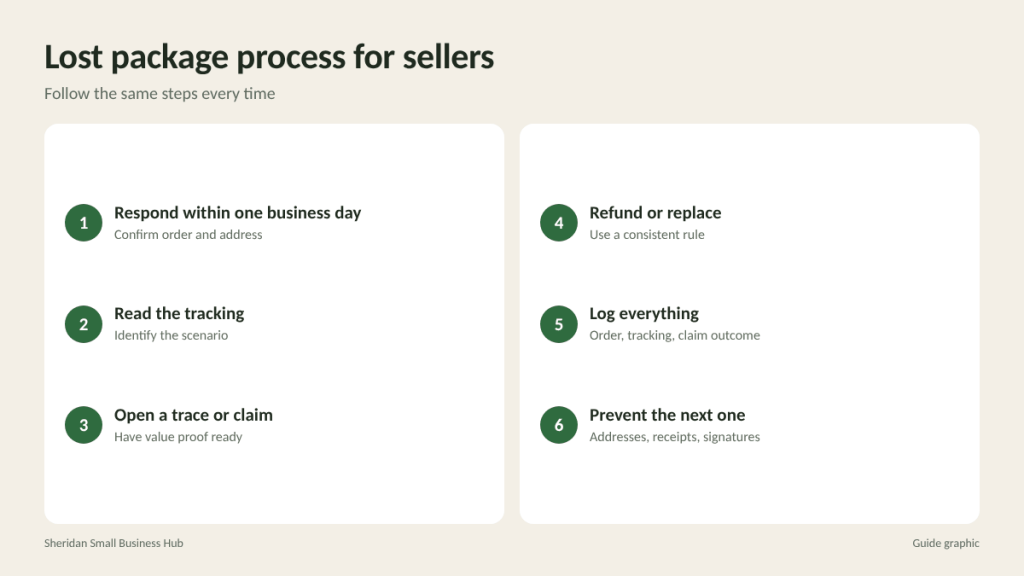
Step 1: Respond fast and calmly
Reply within one business day, even if you have no answer yet. Customers mostly want to know someone is on it. A short message works:
- Thank them for letting you know.
- Confirm the order number and shipping address you have on file.
- Tell them you are checking with the carrier and when you will follow up.
Do not promise a refund or replacement in the first message. You need to see the tracking details first, and a premature promise can lock you into a costly outcome before you know what happened.
Step 2: Read the tracking carefully
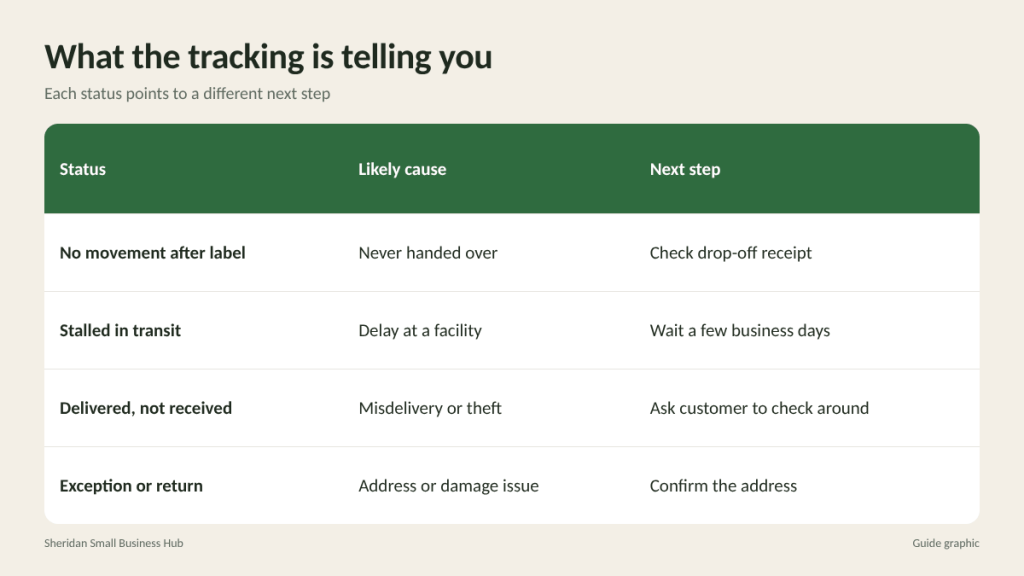
Tracking tells you which kind of problem you have. The main scenarios are:
No movement since label creation
The carrier may never have received the package. Check whether it was actually dropped off or picked up. A drop-off receipt or pickup confirmation is your proof. If you have one, contact the carrier; if not, the package may still be in your shipping area.
In transit but stalled
Packages sometimes sit at a facility for several days, especially during peak seasons or weather events. Give it a few business days past the expected delivery date before treating it as lost, and let the customer know you are monitoring it.
Marked delivered but not received
This is the most common complaint. Ask the customer to check with neighbors, building management, mailrooms and any side or back doors. Look at the delivery details in tracking: some carriers show a photo, a delivery location note or GPS-based information. Many “lost” packages turn up within a day or two.
Returned to sender or exception
An address problem, refused delivery or damage can trigger an exception. The package may already be on its way back to you. Confirm the address with the customer before reshipping.
Step 3: Open a trace or claim with the carrier
For FedEx and UPS shipments, the shipper (that is you, the seller) is usually the party that files a claim, because you have the account and the shipping records. Gather these first:
- Tracking number and ship date.
- Proof of value, such as the invoice or order receipt showing what the customer paid.
- Description of contents and packaging.
- Any declared value you purchased at the time of shipping.
- Photos of the packed item, if you take them as part of your routine.
Carriers set a time window for filing claims, counted from the ship date or scheduled delivery date, so check the current terms on the carrier’s website and do not wait. Also note that carrier liability is limited to a default amount unless you declared a higher value when you shipped. If you sell items worth more than that default, declaring value on high-ticket orders is part of your protection.
If you used a marketplace label or shipping app
Some platforms and shipping apps handle claims or offer their own shipping protection. Check where you bought the label. The claim process may run through that platform rather than the carrier directly.
Step 4: Decide between refund and replacement
You do not need to wait for the claim to finish before taking care of the customer, but you do need a consistent rule. A simple policy:
- Expected date plus a grace period has passed and tracking shows no progress: offer a replacement or refund.
- Marked delivered: ask the customer to check the usual places, wait a short period, and then decide based on order value and customer history.
- High-value orders: wait for the carrier’s trace results when practical, and consider requiring a signature in the future.
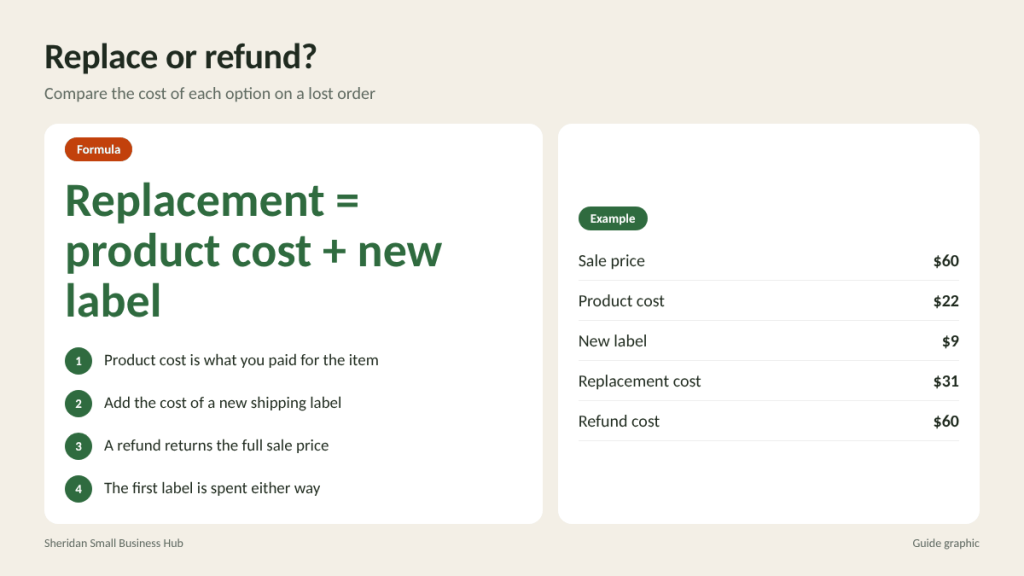
A quick cost check
Say an order sold for $60, the product cost you $22 and shipping cost $9. A replacement costs about $31 ($22 plus $9) and keeps the sale. A full refund costs $60 back to the customer, and you have already spent $9 on the lost label. If you have stock, a replacement is usually cheaper and keeps the customer. If the claim is later paid, it offsets either choice.
Step 5: Document everything
Create a simple lost package log, even a spreadsheet, with these columns: order number, tracking number, carrier, service, date reported, tracking status, action taken, claim number, claim outcome and amount recovered. This log helps in three ways:
- You can respond to chargebacks with dates and evidence.
- You spot patterns, such as one service, region or carrier causing most issues.
- You can flag repeat “not received” claims from the same address.
What to do when customer package is lost: message templates
Having ready-made wording saves time and keeps your tone consistent, even on a stressful day. Adjust these to your brand voice.
First reply
“Thanks for letting us know, and sorry for the trouble. I can see your order was shipped on [date] with tracking number [number]. I am checking with the carrier now and will update you by [day].”
Delivered but not received
“The carrier shows this as delivered on [date] at [time]. Could you check with neighbors, your building office or any side entrances? Packages sometimes turn up a day later. If it has not appeared by [day], reply here and we will make it right.”
Resolution
“We have not been able to locate your package, so we are sending a replacement today. Your new tracking number is [number]. If the original turns up, just let us know.”
Save these in your help desk or email tool as canned responses. Fill in real dates, never vague ones, because a specific follow-up day builds trust and reduces repeat emails.
Step 6: Prevent the next one
Most prevention comes down to a few habits:
- Validate addresses at checkout. Many shipping tools flag missing apartment numbers or mismatched ZIP codes.
- Get proof of drop-off. Ask for a receipt every time, or use scheduled pickups with confirmation.
- Use signature options on high-value orders. It adds friction, but it creates a clear delivery record.
- Offer hold-at-location delivery. Customers who worry about porch theft can pick up from a carrier location instead.
- Package discreetly. Avoid branding that advertises expensive contents on the outside of the box.
- Publish a shipping policy. State how you handle lost packages so customers know what to expect before they order.
Frequently asked questions
Who is responsible for a lost package, the seller or the buyer?
In most online sales, the seller deals with the carrier and is expected to make the customer whole. Your published policy and the platform’s rules shape the details.
How long should I wait before calling a package lost?
Give it a few business days past the expected delivery date, unless tracking shows clear damage or a return. Peak seasons often need a little more patience.
Should I file a police report for a stolen package?
The customer can if they believe it was stolen from their porch. It sometimes helps with insurance claims, but it is not required to file a carrier claim.
Does declared value guarantee I get paid?
No. It raises the carrier’s liability limit, but claims still require proof of value and must meet the carrier’s terms, including packaging standards.
Want a receipt for every package you ship?
Houston sellers can drop off at The Postal Spot, a FedEx Authorized ShipCenter, and leave with proof that each shipment entered the network.